
Native American Cultures |
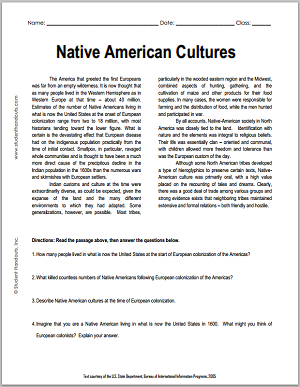 The America that greeted the first Europeans was far from an
empty wilderness. It is now thought that as many people lived in
the Western Hemisphere as in Western Europe at that time – about
40 million. Estimates of the number of Native Americans living
in what is now the United States at the onset of European
colonization range from two to 18 million, with most historians
tending toward the lower figure. What is certain is the
devastating effect that European disease had on the indigenous
population practically from the time of initial contact.
Smallpox, in particular, ravaged whole communities and is
thought to have been a much more direct cause of the precipitous
decline in the Indian population in the 1600s than the numerous
wars and skirmishes with European settlers. The America that greeted the first Europeans was far from an
empty wilderness. It is now thought that as many people lived in
the Western Hemisphere as in Western Europe at that time – about
40 million. Estimates of the number of Native Americans living
in what is now the United States at the onset of European
colonization range from two to 18 million, with most historians
tending toward the lower figure. What is certain is the
devastating effect that European disease had on the indigenous
population practically from the time of initial contact.
Smallpox, in particular, ravaged whole communities and is
thought to have been a much more direct cause of the precipitous
decline in the Indian population in the 1600s than the numerous
wars and skirmishes with European settlers.Indian customs and culture at the time were extraordinarily diverse, as could be expected, given the expanse of the land and the many different environments to which they had adapted. Some generalizations, however, are possible. Most tribes, particularly in the wooded eastern region and the Midwest, combined aspects of hunting, gathering, and the cultivation of maize and other products for their food supplies. In many cases, the women were responsible for farming and the distribution of food, while the men hunted and participated in war. By all accounts, Native-American society in North America was closely tied to the land. Identification with nature and the elements was integral to religious beliefs. Their life was essentially clan – oriented and communal, with children allowed more freedom and tolerance than was the European custom of the day. Although some North American tribes developed a type of hieroglyphics to preserve certain texts, Native-American culture was primarily oral, with a high value placed on the recounting of tales and dreams. Clearly, there was a good deal of trade among various groups and strong evidence exists that neighboring tribes maintained extensive and formal relations – both friendly and hostile. |
Directions: Read the text above, then answer the
questions below. |
1. How many people lived in what is now the
United States at the start of European colonization of the
Americas? 2. What killed countless numbers of Native Americans following European colonization of the Americas? 3. Describe Native American cultures at the time of European colonization. 4. Imagine that you are a Native American living in what is now the United States in 1600. What might you think of European colonists? Explain your answer. |
Click here to print. |
 |
 |
 |
 |
 |
 |
| Early America Books and Films | Early America Image Galleries |
| Early America Learning and Study Games | Early America Miscellany |
| Early America Outlines and PowerPoints | Early America Worksheets |
Text courtesy of the U.S. State Department,
Bureau of International Information Programs, 2005 |