Victory and Independence |
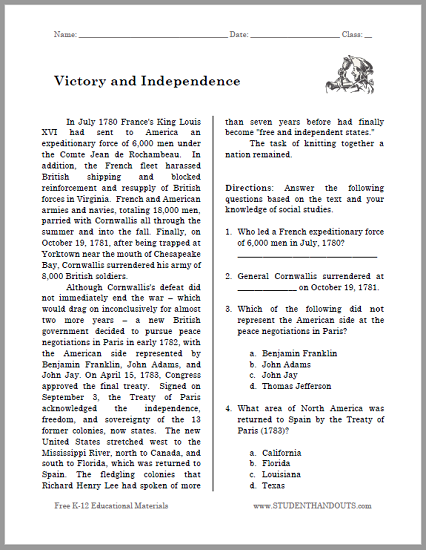
| In July 1780 France's King Louis XVI had sent to America an expeditionary force of 6,000 men under the Comte Jean de Rochambeau. In addition, the French fleet harassed British shipping and blocked reinforcement and resupply of British forces in Virginia. French and American armies and navies, totaling 18,000 men, parried with Cornwallis all through the summer and into the fall. Finally, on October 19, 1781, after being trapped at Yorktown near the mouth of Chesapeake Bay, Cornwallis surrendered his army of 8,000 British soldiers. |
 |
    |
|---|
Although Cornwallis's defeat did not immediately end the war
– which would drag on inconclusively for almost two more years –
a new British government decided to pursue peace negotiations in
Paris in early 1782, with the American side represented by
Benjamin Franklin, John Adams, and John Jay. On April 15, 1783,
Congress approved the final treaty. Signed on September 3,
the Treaty of Paris acknowledged the independence, freedom, and
sovereignty of the 13 former colonies, now states. The new
United States stretched west to the Mississippi River, north to
Canada, and south to Florida, which was returned to Spain. The
fledgling colonies that Richard Henry Lee had spoken of more
than seven years before had finally become "free and independent
states." The task of knitting together a nation remained. Questions with answers in bold: 1. Who led a French expeditionary force of 6,000 men in July, 1780? |
| Click here to print. |
Text courtesy of the U.S. State Department, Bureau of International Information Programs, 2005 |