Click here to print. Click here to print the answer key.
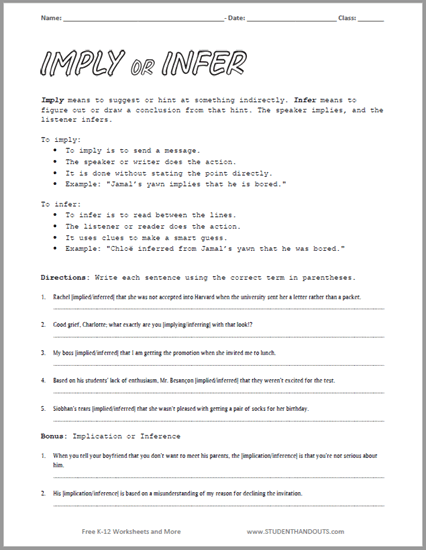
Imply means to suggest or hint at something indirectly. Infer means to figure out or draw a conclusion from that hint. The speaker implies, and the listener infers.
To imply:
- To imply is to send a message.
- The speaker or writer does the action.
- It is done without stating the point directly.
- Example: "Jamal's yawn implies that he is bored."
To infer:
- To infer is to read between the lines.
- The listener or reader does the action.
- It uses clues to make a smart guess.
- Example: "Chloë inferred from Jamal's yawn that he was bored."
Directions: Write each sentence using the correct term in parentheses.
- Rachel [implied/inferred] that she was not accepted into Harvard when the university sent her a letter rather than a packet.
- Good grief, Charlotte; what exactly are you trying to [imply/infer] with that smug look!?
- My boss [implied/inferred] that I am getting the promotion when she invited me to lunch.
- Based on his students' lack of enthusiasm, Mr. Besançon [implied/inferred] that they weren’t excited for the test.
- Siobhan's tears [implied/inferred] that she wasn’t pleased with getting a pair of socks for her birthday.
Bonus: Implication or Inference
- When you tell your boyfriend that you don't want to meet his parents, the [implication/inference] is that you're not serious about him.
- His [implication/inference] is based on a misunderstanding of my reason for declining the invitation.
Teachers: Please note that the second exercise in the first batch is purposely ambiguous. Charlotte could be implying or inferring. Contextually and in common usage, the answer is imply. However, in a tense confrontation, the speaker might use infer in order to emphasis the speaker's belief that Charlotte is willfully misunderstanding the speaker.
A rule of thumb is to assume that the author used the term correctly; ergo, if infer is used in this line of dialogue, the speaker is accusing Charlotte of seeking to find an unpleasant meaning in the speaker's words. |