

| Writing Exercises on the U.S. in the 1980s |
|---|
| www.studenthandouts.com ↣ U.S. History ↣ New Conservatism ↣ New Conservatism Worksheets |
 |
    |
|
Click here to print (PDF file). Students' answers will vary.
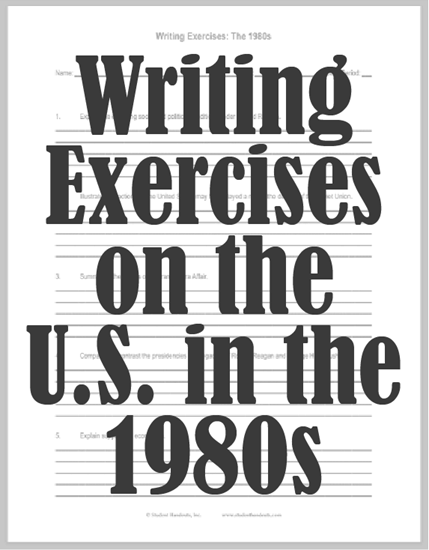
1. Explain the changing social and political conditions under Ronald Reagan. Reagan's presidency shifted political conditions by championing conservatism, deregulation, and tax cuts. Socially, his era saw the rise of the Religious Right, a focus on "family values," and a renewed sense of national optimism, though it also widened economic inequality. 2. Illustrate how actions by the United States may have played a role in the demise of the Soviet Union. The United States intensified the Cold War's final chapter through a massive military buildup under Reagan, challenging the U.S.S.R. to keep pace. This defense spending, combined with pressure on Soviet allies and support for anti-communist movements, strained an already failing Soviet economy and contributed to its collapse. 3. Summarize the events of the Iran-Contra Affair. The Iran-Contra Affair was a secret Reagan administration operation. Senior officials facilitated illegal weapons sales to Iran, hoping to secure the release of American hostages. Profits from these sales were then covertly funneled to fund anti-communist Contra rebels in Nicaragua, directly defying a congressional ban. 4. Compare and contrast the presidencies and legacies of Ronald Reagan and George H.W. Bush. Reagan championed conservative ideology with sweeping tax cuts and anti-communist rhetoric, leaving a legacy of realignment. Bush, more pragmatic, continued foreign policy successes like the Gulf War but broke his "no new taxes" pledge, alienating his base and shifting the party further right. 5. Explain supply-side economics. Supply-side economics argues that broad tax cuts and deregulation stimulate economic growth. The theory posits that lowering barriers for producers ("supply") increases investment, boosts production, creates jobs, and ultimately generates more government revenue, counteracting the initial loss from tax cuts. |
| www.studenthandouts.com ↣ U.S. History ↣ New Conservatism ↣ New Conservatism Worksheets |