
| Modern Immigration Issues Essay Questions |
|---|
| www.studenthandouts.com ↣ U.S. History ↣ New Conservatism ↣ New Conservatism Worksheets |
 |
    |
|
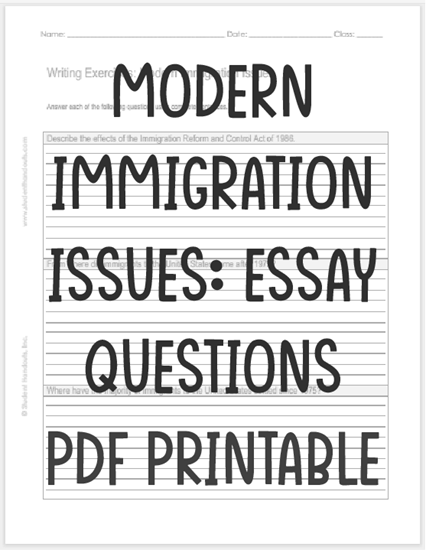
Modern Immigration Issues: Essay Questions—Sheet 1:
1 Describe the effects of the Immigration Reform and Control Act of 1986. The IRCA granted amnesty to nearly 3 million undocumented immigrants, legalizing their status. It also established employer sanctions for knowingly hiring unauthorized workers, creating the I-9 verification system, though it ultimately failed to stop illegal immigration. 2 From where did immigrants to the United States come after 1975? After 1975, U.S. immigrants primarily came from Latin America and Asia. This shift was driven by the 1965 Immigration Act, which favored family reunification, and was followed by refugee waves from Vietnam, Cuba, and later Central America. 3 Where have the majority of immigrants to the United States settled since 1975? Since 1975, most immigrants have settled in major metropolitan areas, but increasingly in new "gateways" across the South and West, such as Atlanta, Dallas, and Washington, D.C. A significant trend is their predominant settlement in the suburbs of these cities rather than in urban centers. Click here to print. Answers will vary. Modern Immigration Issues: Essay Questions—Sheet 2: 1 Compare and contrast the experiences of immigrant groups today with those of immigrant groups circa 1900. Modern immigrants often possess higher education and professional skills, integrating into a suburban, service-based economy. Unlike the largely poor, unskilled, and illiterate European wave of 1900 that clustered in urban ethnic enclaves, today's groups are more diverse and may encounter a different, though persistent, climate of xenophobia. 2 Describe the economic, political, and social implications of a growing elderly population. An aging population strains public finances, increasing healthcare and pension costs while shrinking the tax base. Politically, it creates pressure to protect entitlements, potentially sparking generational conflict. Socially, it shifts family structures and labor markets, slowing economic dynamism and demanding a larger caregiving workforce. 3 Describe shifting demographics in the American "Rust Belt." Use a specific city as an example. The Rust Belt faced population decline and aging as industries shuttered. For example, Detroit lost over a million residents after 1950. This exodus left a predominantly older, African American population with vacant housing, strained city services, and a shrinking tax base. Click here to print. Answers will vary. |
| www.studenthandouts.com ↣ U.S. History ↣ New Conservatism ↣ New Conservatism Worksheets |