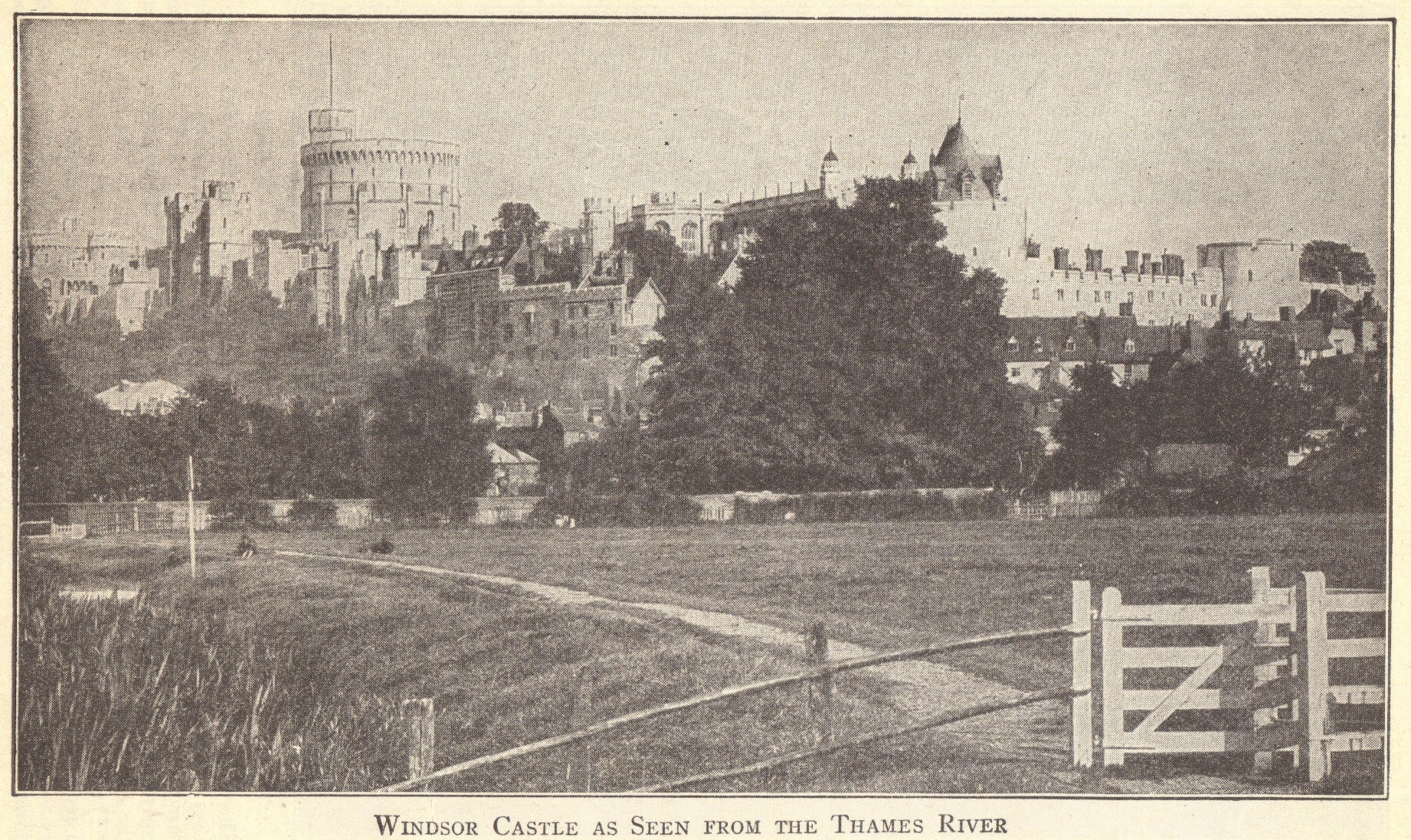
Windsor Castle as seen from the Thames River; Berkshire, England. This well-known royal residence dates to the time of William the Conqueror. Click here to enlarge this image.
Windsor Castle, the oldest and largest inhabited castle in the world, is a monumental testament to nearly a millennium of evolving architectural styles. Its construction began in the 11th century under William the Conqueror, establishing the original motte-and-bailey fortification with a central timber keep on the earth mound still seen today. Successive monarchs transformed it from a strategic stronghold into a palatial royal residence.
The castle's architecture is a profound historical record. The formidable, curtain-walled Lower Ward contrasts with the more domestic Upper Ward, arranged around a central quadrangle. The iconic Round Tower, rebuilt in stone by Henry II, crowns the original motte.
A pivotal transformation occurred in the 14th century under Edward III, who created the Gothic masterpiece of St. George's Chapel––a soaring perpendicular marvel that remains a centrepiece.
The castle's state apartments were later redesigned in Baroque and Rococo styles after a fire in 1992, which prompted a massive, historically sensitive restoration. The result is a unique palimpsest: a working fortress, a Gothic ecclesiastical complex, and a sumptuous royal palace, all harmonised within its sweeping walls, embodying the continual adaptation of British monarchy across the ages.
Your K-12 pupils should learn about Windsor Castle because it helps them understand British history, royal traditions, and architecture. Built nearly 1,000 years ago, it is one of the oldest and largest occupied castles in the world. Studying Windsor Castle helps students discover how monarchs lived and how historic landmarks continue to shape culture today.
|