
| Punnett Square Dihybrid Cross |
|---|
| www.studenthandouts.com ↣ Science ↣ Biology |
 |
    |
|
Click here to print the worksheet above.
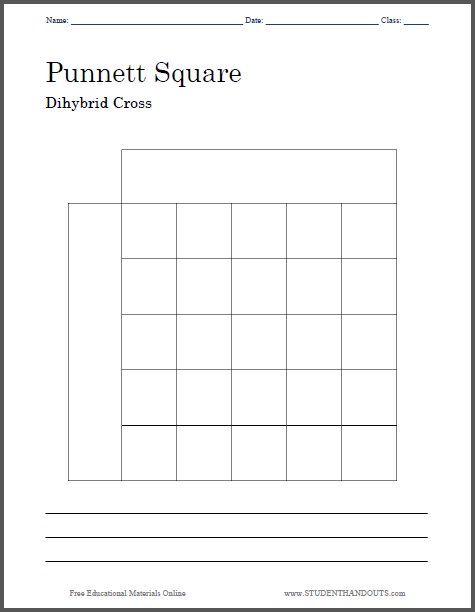
Click here to print a worksheet with four Punnett squares for dihybrid crosses. Completing a dihybrid Punnett square—which tracks two traits—follows a clear, four-step method. First, determine the genotypes of both parents. For example, crossing two heterozygous parents for seed shape (Rr) and color (Yy) gives a parental genotype of RrYy for each. Second, using the FOIL method, list all possible gamete combinations for one parent. For RrYy, the four gametes are RY, Ry, rY, and ry. Third, draw a 4x4 grid. Place one parent's four gametes along the top and the other's identical four along the left side. Finally, fill each square by combining the alleles from the corresponding row and column headers. This creates 16 possible offspring genotypes. To finish, analyze the results for phenotypic ratios; in this classic cross, you would find a 9:3:3:1 ratio of dominant/dominant, dominant/recessive, recessive/dominant, and recessive/recessive traits, respectively. This structured approach systematically predicts genetic variation in offspring. Looking for a Punnet square monohybrid cross worksheet? Then click here. |
| www.studenthandouts.com ↣ Science ↣ Biology |