As students enter high school and begin studying major military conflicts in depth for the first time, they are encountered with terminology (in documentaries and in print) which will be largely unfamiliar to them outside of (perhaps) motion pictures and network news. What is a skirmish? What are civilians?
In order to better understand the content of high school history courses, and write better essays, we've prepared handy worksheets that help with an understanding of "fighting words."
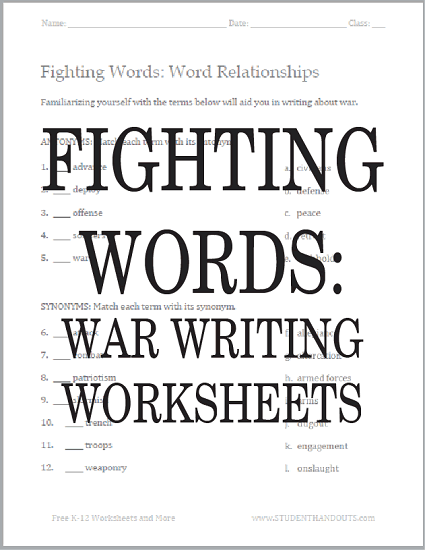
Here are 24 key terms which students should know when writing about war. The worksheet shown above has students match synonyms and antonyms.
Click here to print (PDF file) this worksheet.
Answer Key: (1) D (2) E (3) B (4) A (5) C (6) L (7) K (8) F (9) G (10) J (11) H (12) I
Teaching Idea: Have students write a five-paragraph essay describing a battle or altercation, requiring them to use at least a dozen of these terms. Perhaps have students write in the style of a war correspondent. Additionally, have students watch or read war reports, and pick out how many of these terms they hear or see.
We also have a worksheet that asks students to define all 24 terms, which you can print here.
- Advance: A military move forward toward an enemy position to gain ground or tactical advantage.
- Allegiance: Loyalty and commitment to a nation, leader, or cause, often expressed through oath or duty.
- Altercation: A brief, heated verbal dispute or minor physical conflict, usually unplanned.
- Armed forces: A nation's military branches (army, navy, air force, etc.) trained for national defense and combat.
- Arms: Weapons and ammunition used in warfare, from firearms to missiles and explosives.
- Attack: An aggressive military action intended to inflict damage, capture ground, or destroy enemy forces.
- Civilians: Non-military citizens who are not part of armed forces, especially during wartime.
- Combat: Active fighting between opposing military forces, typically involving direct weapons engagement.
- Defense: Military actions taken to protect territory, assets, or populations from enemy attack.
- Deploy: To position and spread military forces, equipment, or resources for a specific mission.
- Dugout: A protective trench or shelter excavated from earth, used by soldiers against shellfire.
- Engagement: A battle or encounter between opposing military forces, lasting from minutes to days.
- Offense: Aggressive military operations aimed at attacking enemy forces or capturing territory.
- Onslaught: A fierce, powerful, and sustained military attack against an enemy position.
- Patriotism: Devotion and emotional attachment to one's own nation, including willingness to defend it.
- Peace: A period without armed conflict, often formalized by treaties between formerly warring parties.
- Retreat: Withdrawal of military forces from a battle position, often to avoid defeat or regroup.
- Skirmish: A minor, brief, and unplanned battle between small military units or patrols.
- Soldiers: Trained military personnel who serve in an army, engaging in combat and other duties.
- Trench: A long, narrow excavation in the ground providing cover for soldiers from enemy fire.
- Troops: Collective term for groups of soldiers or military units, especially deployed for operations.
- War: Sustained, large-scale armed conflict between nations, states, or armed groups, involving organized forces.
- Weaponry: The full range of weapons used in combat, including firearms, explosives, and chemical arms.
- Withhold: To deliberately keep back resources, support, or information from military forces or allies.
For a worksheet asking students to use each word in a sentence, click here.
|