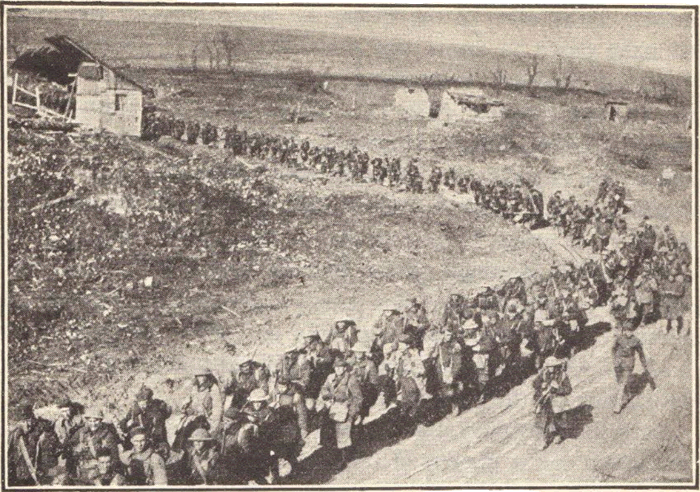
Heroes of the Meuse-Argonne, World War I: From an official army photograph. Soldiers of the First Division A.E.F., near the Meuse River, November 9, 1918. This division had twice been in line during the Meuse-Argonne battle, besides taking part in previous battles. Click here to enlarge this image.
The Meuse-Argonne Offensive, fought from September 26 to November 11, 1918, was the largest and bloodiest American military operation in World War I, involving 1.2 million U.S. soldiers of the American Expeditionary Forces under General John J. Pershing. Part of the broader Allied Hundred Days Offensive, its objective was to sever the vital German rail network at Sedan, thereby crippling the enemy's supply lines and forcing a general retreat.
The battle unfolded in three grueling phases across the dense, hilly terrain of the Argonne Forest and along the Meuse River, heavily fortified by the Germans with intricate trench systems and machine-gun nests. Initial American advances were swift but soon bogged down against determined resistance, leading to brutal, attritional warfare. By early October, U.S. forces, alongside French colonial troops, had broken through the main German defensive lines, though at tremendous cost.
The final push in November saw the exhausted but relentless Americans achieve a decisive breakthrough, contributing directly to the collapse of German morale and the armistice. The victory came at a high price: over 26,000 American soldiers were killed and 95,000 wounded. The Meuse-Argonne was a seminal test for the U.S. Army, demonstrating its growing effectiveness and playing a pivotal role in ending the war.
|