

| European Explorers Chart Worksheets |
|---|
| www.studenthandouts.com ↣ World History ↣ Age of Exploration Teaching Materials ↣ Age of Exploration Worksheets |
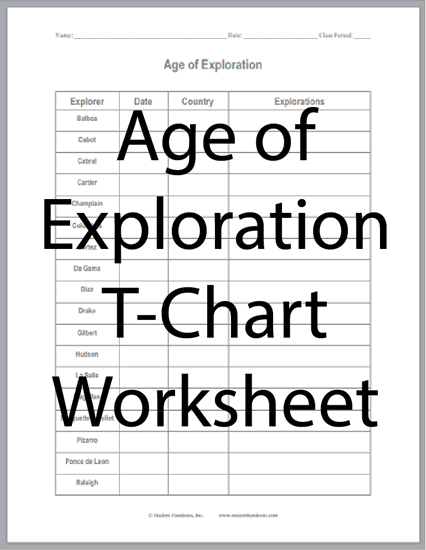
| Students are asked to complete the following chart, describing the explorations of the following: Balboa, Cabot, Cabral, Cartier, Champlain, Columbus, Cortez, De Gama, Diaz, Drake, Gilbert, Hudson, La Salle, Magellan, Marquette and Joliet, Pizarro, Ponce de Leon, and Raleigh. |
 |
    |
|
Click here to print (PDF). Answers will vary.
Vasco Núñez de Balboa: Balboa, a Spanish explorer, is known for crossing the Isthmus of Panama in 1513 and becoming the first European to reach the Pacific Ocean. He claimed the Pacific and all its shores for Spain. John Cabot (Giovanni Caboto): An Italian explorer sailing under the English flag, Cabot is credited with discovering parts of North America, likely the coast of Newfoundland, around 1497. Pedro Álvares Cabral: This Portuguese explorer is noted for his 1500 expedition to Brazil. While en route to India, he accidentally discovered the eastern coast of South America, making him one of the first Europeans to set foot in Brazil. Jacques Cartier: A French explorer, Cartier is best known for his explorations of Canada, including the Gulf of St. Lawrence and the St. Lawrence River, in the early 16th century. Samuel de Champlain: A French explorer, Champlain is often called the "Father of New France." He founded Quebec City in 1608 and made numerous journeys exploring the Great Lakes and northeastern North America. Christopher Columbus (Cristoforo Colombo): The Italian explorer sailing for Spain is renowned for his four voyages to the Americas (1492, 1493, 1498, and 1502). His voyages marked the beginning of European exploration in the New World. Hernán Cortés: Cortés, a Spanish conquistador, is famous for his conquest of the Aztec Empire in Mexico (1519-1521), leading to the establishment of New Spain. Vasco da Gama: A Portuguese explorer, da Gama is known for his successful voyage around the Cape of Good Hope to reach India in 1498, establishing a sea route to the East. Bartolomeu Días: Another Portuguese explorer, Dias is the first European known to have sailed around the southern tip of Africa, known as the Cape of Good Hope, in 1488. Francis Drake: An English privateer and explorer, Drake circumnavigated the globe (1577-1580) and was involved in the English defeat of the Spanish Armada in 1588. Sir Humphrey Gilbert: An English explorer, Gilbert attempted to establish a settlement in Newfoundland in 1583 but died at sea on the return journey. Henry Hudson: An English explorer sailing for the Dutch, Hudson explored parts of North America, including the Hudson River, in the early 17th century. René-Robert Cavelier, Sieur de La Salle: A French explorer, La Salle is known for his extensive explorations of the Mississippi River and the Gulf of Mexico in the late 17th century. He claimed the entire Mississippi River Valley for France. Ferdinand Magellan: A Portuguese explorer sailing for Spain, Magellan led the first expedition to circumnavigate the Earth (1519-1522), though he was killed in the Philippines. Jacques Marquette and Louis Joliet: Marquette, a French Jesuit missionary, and Joliet, a French-Canadian explorer, are credited with exploring the Mississippi River in 1673. They sought a water route to the Pacific. Francisco Pizarro: A Spanish conquistador, Pizarro is famous for his conquest of the Inca Empire in Peru (1532-1533), leading to the establishment of New Castile. Juan Ponce de León: A Spanish explorer, Ponce de León is known for discovering Florida in 1513 and is associated with the legend of the Fountain of Youth. Sir Walter Raleigh: An English explorer and soldier, Raleigh sponsored the failed Roanoke Island colony in the late 16th century. These explorers made significant contributions to the Age of Exploration, expanding geographical knowledge and influencing the course of history in the Americas, Africa, and Asia. |
 |     |
|
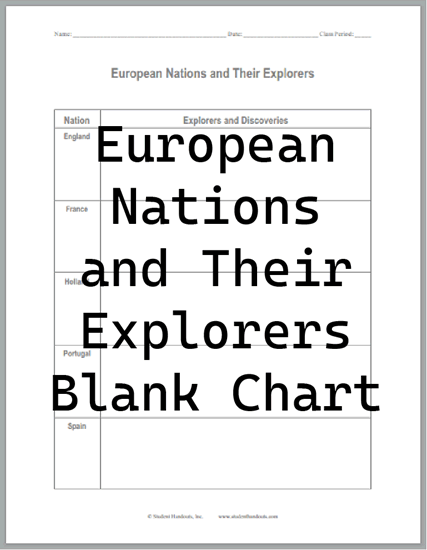
Students are asked to list and describe the explorers of five European nations: England, France, Holland (Netherlands), Portugal, and Spain.
Click here to print (PDF). Answers will vary. England––John Cabot (Giovanni Caboto): An Italian explorer sailing under the English flag, Cabot is credited with discovering parts of North America in 1497. His journey to Newfoundland marked the first known European exploration of North America since the Norse. France––Jacques Cartier: Cartier was a French explorer who made three voyages to North America between 1534 and 1542. He explored the Gulf of St. Lawrence, discovered the St. Lawrence River, and claimed Canada for France. His explorations helped lay the foundation for French claims in the New World. Netherlands (Holland)––Henry Hudson: An English explorer working for the Dutch East India Company, Hudson is known for his voyages in the early 17th century. He explored areas like the Hudson River and Hudson Bay, which are now named after him. Hudson's expeditions contributed to Dutch territorial claims in North America. Portugal––Vasco da Gama: Vasco da Gama was a Portuguese explorer who famously sailed around the southern tip of Africa (the Cape of Good Hope) in 1497-1498, establishing a sea route to India. This voyage opened up direct access to valuable spices and goods from the East. Spain––Christopher Columbus (Cristoforo Colombo): Columbus, an Italian explorer sailing under the Spanish flag, embarked on four voyages to the Caribbean and the Americas between 1492 and 1504. His first voyage in 1492 led to the rediscovery of the Americas by Europeans. Columbus is often credited with opening the way for Spanish exploration and colonization in the New World. Spain––Ferdinand Magellan (Fernão de Magalhães): Magellan, a Portuguese explorer sailing under the Spanish flag, is best known for leading the first expedition to circumnavigate the globe (1519-1522). While he died during the journey, his fleet completed the circumnavigation, demonstrating the vastness of the Earth and the possibilities of global exploration. These explorers from different European nations made significant contributions to the Age of Exploration, which transformed the world by expanding knowledge, trade routes, and territorial claims during the late 15th and early 16th centuries. |
| www.studenthandouts.com ↣ World History ↣ Age of Exploration Teaching Materials ↣ Age of Exploration Worksheets |