
| Ancient Israelites Maps and Pictures |
|---|
| www.studenthandouts.com ↣ World History ↣ Ancient Near East Educational Materials ↣ Ancient Near East Maps & Pictures |
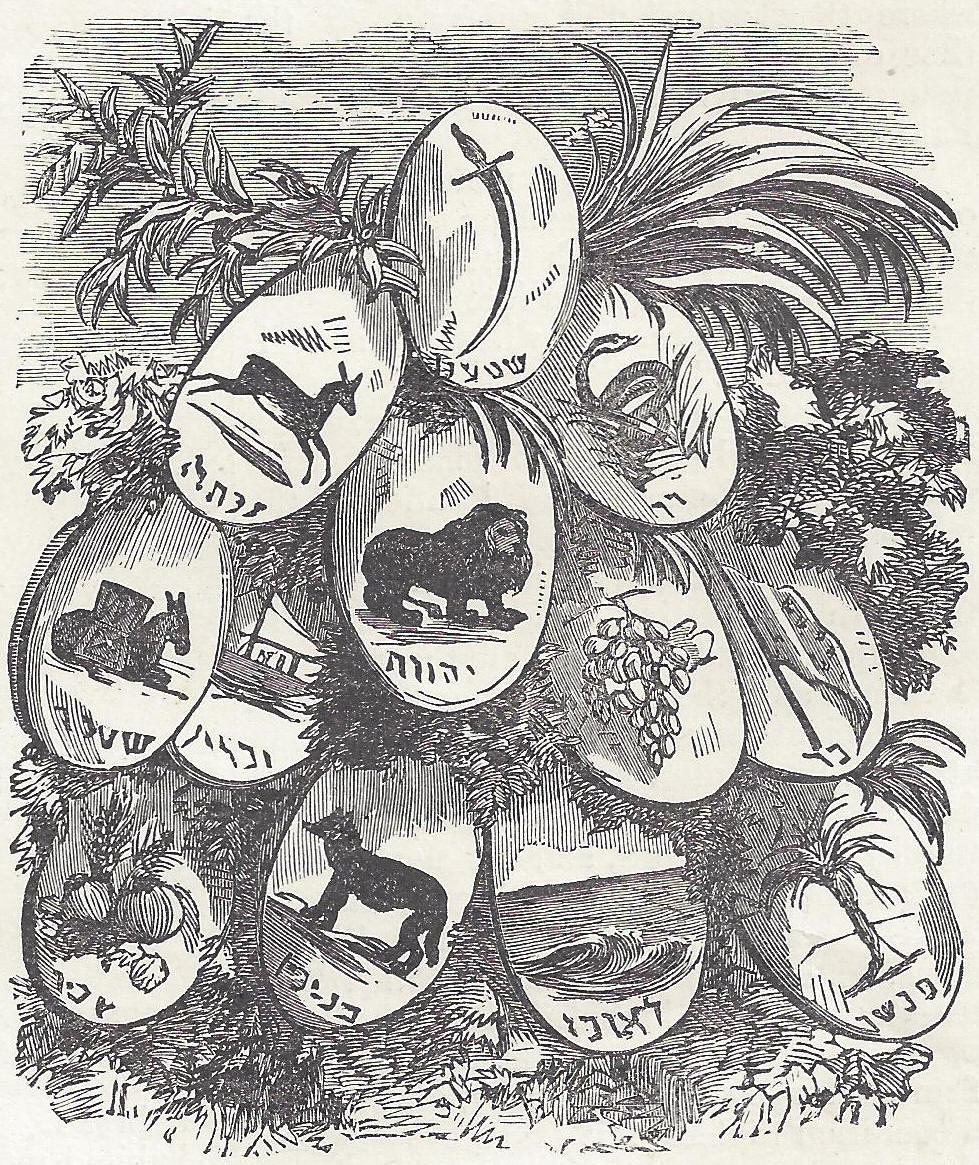 These are the emblems of the standards of the twelve tribes of Israel. The twelve tribes were descended from the sons of Jacob, who was the grandson of Abraham through Isaac.
These twelve sons were: Benjamin, Joseph, Naphtali (or Naphthali), Dan, Zebulan (also spelt Zebulon or Zebulun), Issachar, Judah, Levi, Simeon, Reuben, Ashe (or Asher), and Gad. Extension activity: Ask students to alphabetize the names of the tribes. |
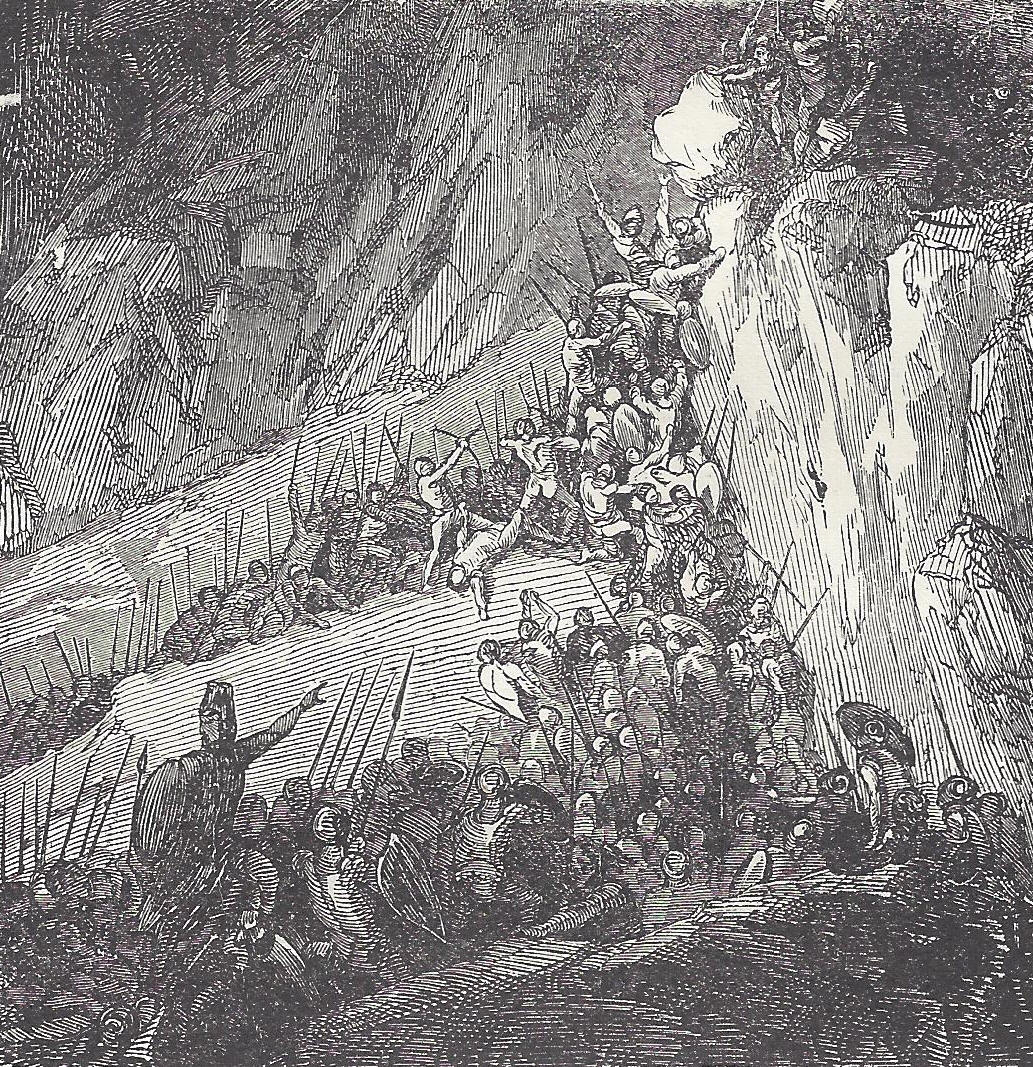 According to the Bible, Moses sent a member of each tribe to spy in Canaan. After forty days, the men returned with an unfavorable report. All but Joshua and Caleb stated that the land was populated by giants living in heavily fortified cities. These reports terrified the Israelites. When Moses, Aaron, Joshua, and Caleb tried to calm the people down, a blaze sent from God came from the Tabernacle, restoring the people to their senses.
Moses begged God to forgive the crowd. God did, but held that, excepting Caleb and Joshua, no living male Israelite then aged twenty years and older would ever enter the Promised Land. This would lead to another 38 years spent wandering in the wilderness. But before embarking on their sojourn in the desert for an additional 38 years, the Israelites attempted to force their way through a mountain pass. This pass was held by a joint army of Canaanites and Amalekites, who bloodily repulsed the Israelite invaders. |
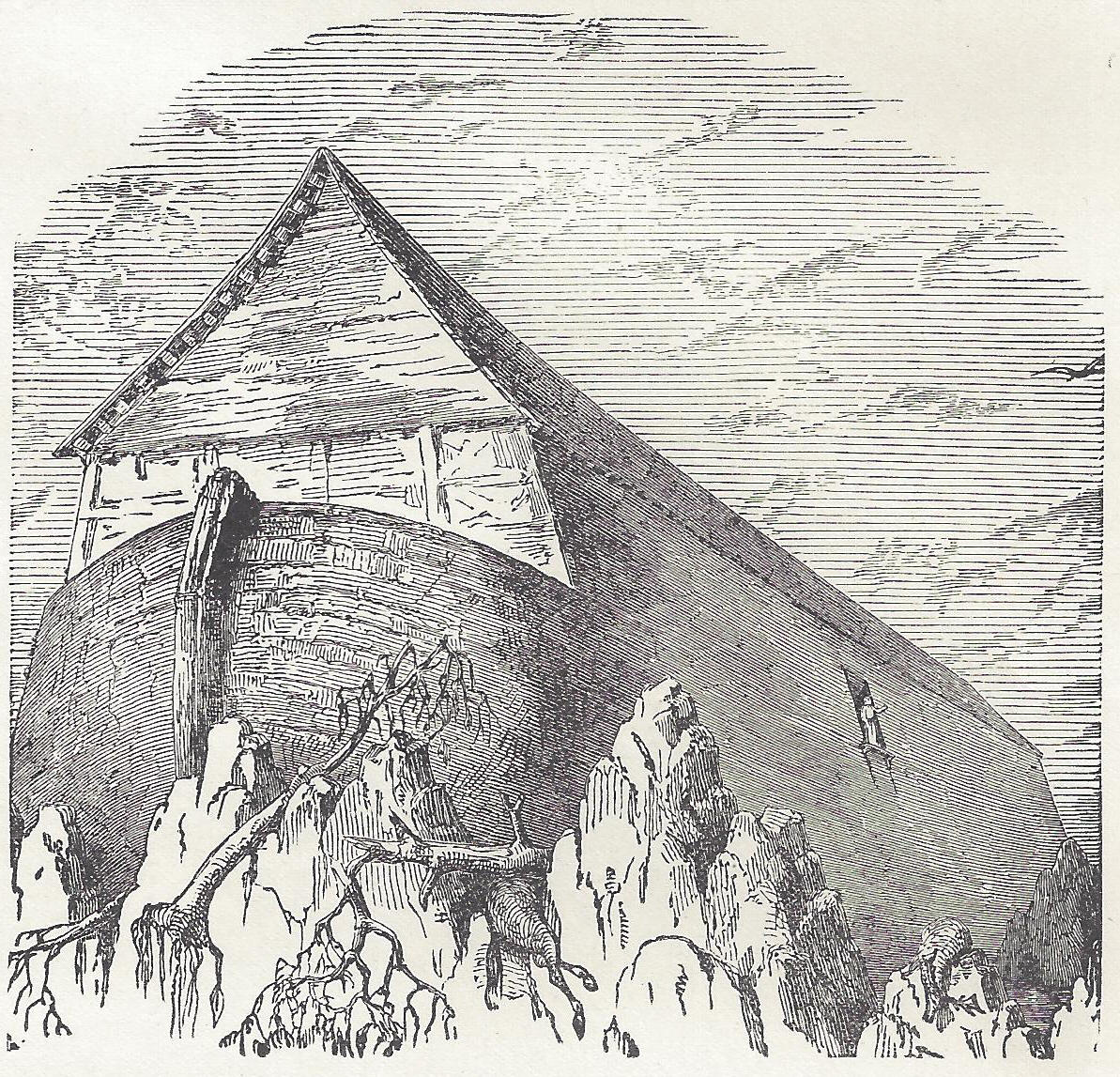 This engraving depicts Noah's famous ark. Similar to a Mesopotamian story found in the Epic of Gilgamesh, the Christian Bible (Hebrew Torah) tells a story about a man named Noah, commanded by God to build an ark.
God sent a flood that covered the entire earth. Noah was later able to repopulate the earth because he had brought his family, along with two of each living creature, into the ark to ride out the flood. |
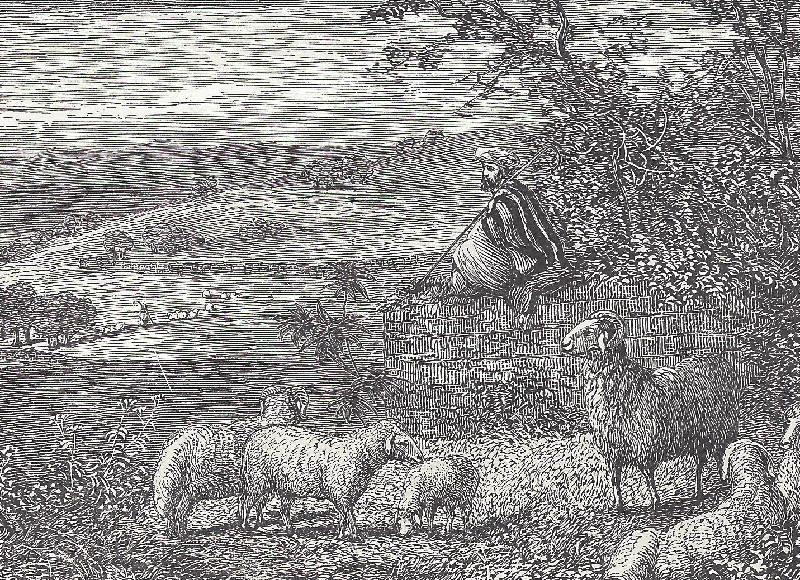 This image depicts a shepherd tending his flocks during the time of the Old Testament. According to tradition, the ancient Hebrews began as pastoral nomads, emigrating from Ur.
God directed Abraham to lead his people into the land of Canaan, roughly equivalent to modern-day Israel. Extension activity for students: Compare and contrast the work and lifestyle of Levantine shepherds then (late Bronze Age/early Iron Age) and now. |
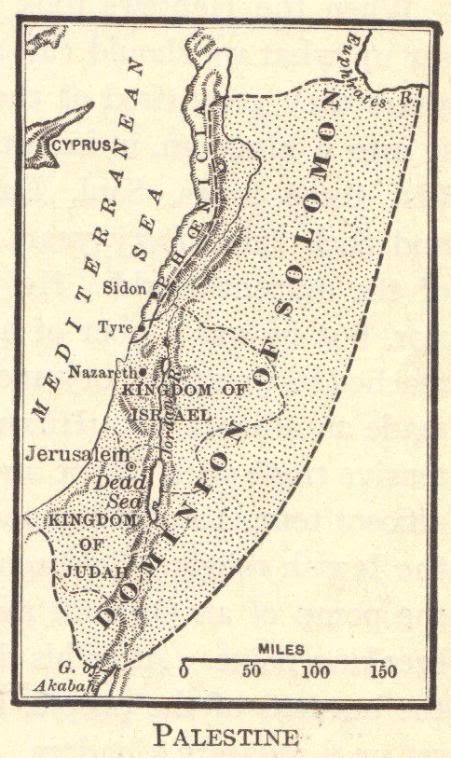 Map of ancient Israel, Judea/Judah, Phoenicia, Palestine. Map of ancient Israel, Judea/Judah, Phoenicia, Palestine.
The dominion of King Solomon of the Hebrews of Jerusalem. Extension activity: Ask students to research the extent of Solomon's dominion. How is the maximum extent calculated? For how long was this land held? |
 Family tree chart of Abraham through the Twelve Tribes of Israel. Family tree chart of Abraham through the Twelve Tribes of Israel.
This family tree chart shows Abraham's descendants through his wives Keturah and Sarah, and concubine, Hagar. Abraham's son, Isaac, fathered Jacob. Jacob's twelve sons founded the twelve tribes of Israel. Continue reading |
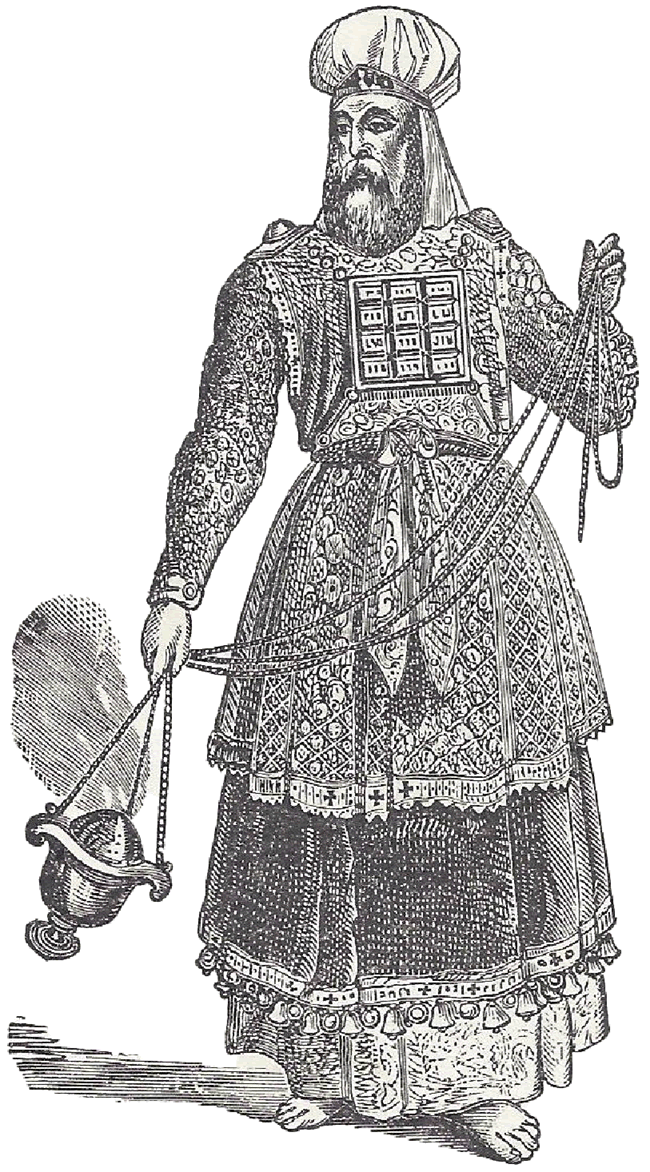 Aaron, the brother of Moses, is shown dressed in his ceremonial garb as high priest (kohen gadol) of the ancient Israelites.
The priestly succession was to pass through Aaron's male line. Click for image version: JPG PNG SVG Question for students: Is there a role for the kohen gadol in modern synagogues? Explain. |
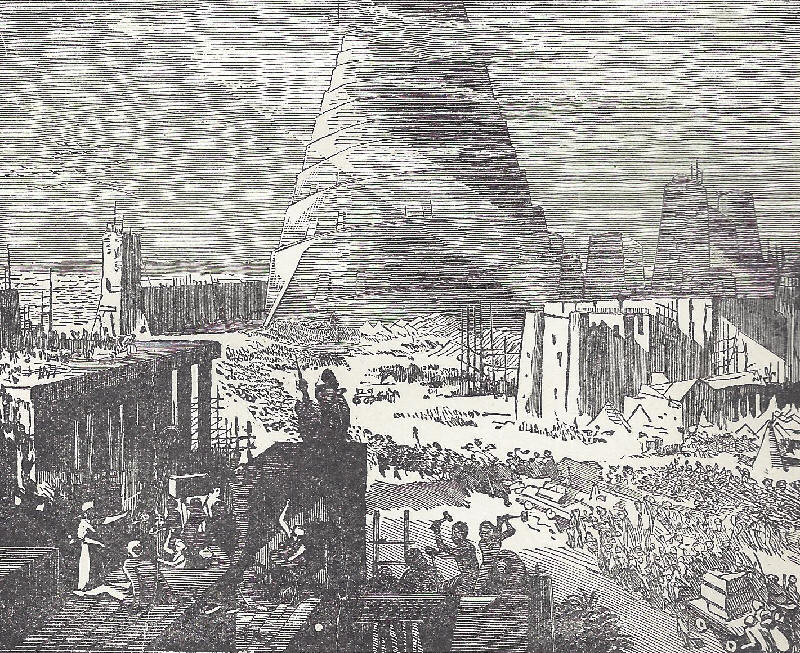 According to Abrahamic religious tradition, the people of ancient Babylonia brought upon themselves the wrath of God in their attempt to build a temple (described much like a ziggurat) that would reach to the heavens.
As punishment, God caused groups of people to speak different languages. This is the biblical explanation for the origin of human languages. Extension activity: Have students do online research to view the archæological ruins of ancient ziggurats. |
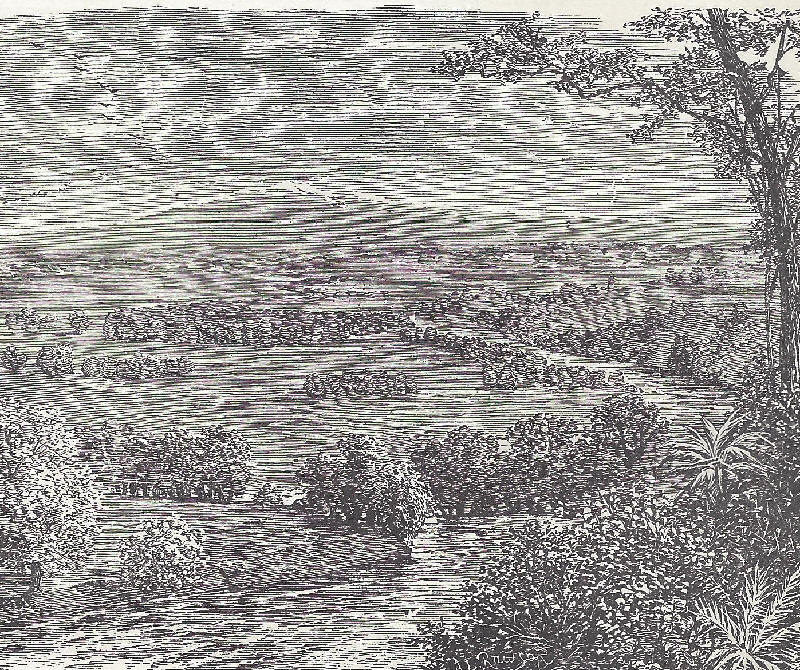 The Valley of the Jordan as it appeared in biblical times.
The Jordan Valley is a deep, fertile rift valley in the Middle East, forming part of the Great Rift Valley. It contains the Jordan River and borders Israel, the West Bank, and Jordan. Known for its date farms and mineral-rich Dead Sea, it holds immense historical and agricultural significance. Question for students: Compare and contrast the role of the Jordan Valley in biblical times and today. |
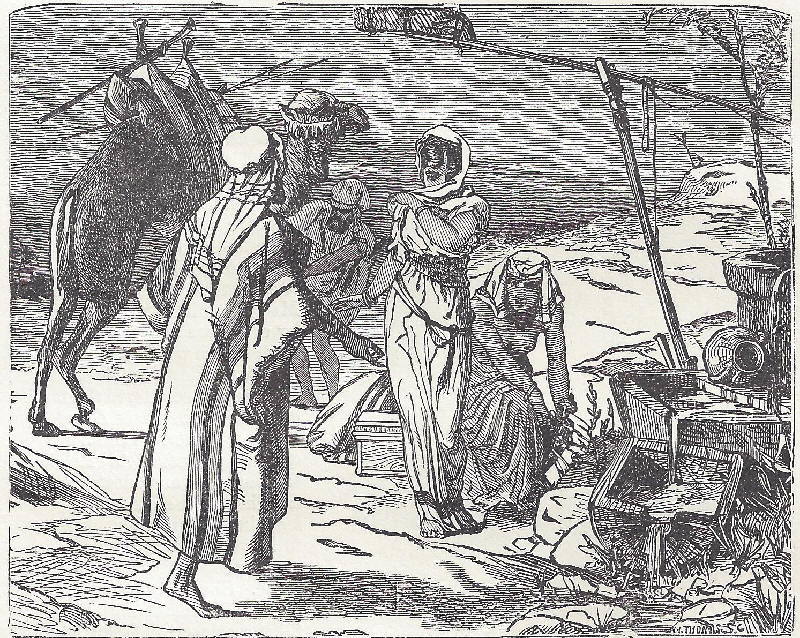 According to accounts in Genesis, Eliezer traveled to Haran and selected Rebekah as Isaac's wife. This image depicts Isaac meeting Rebekah for the first time, following her journey to Canaan.
|
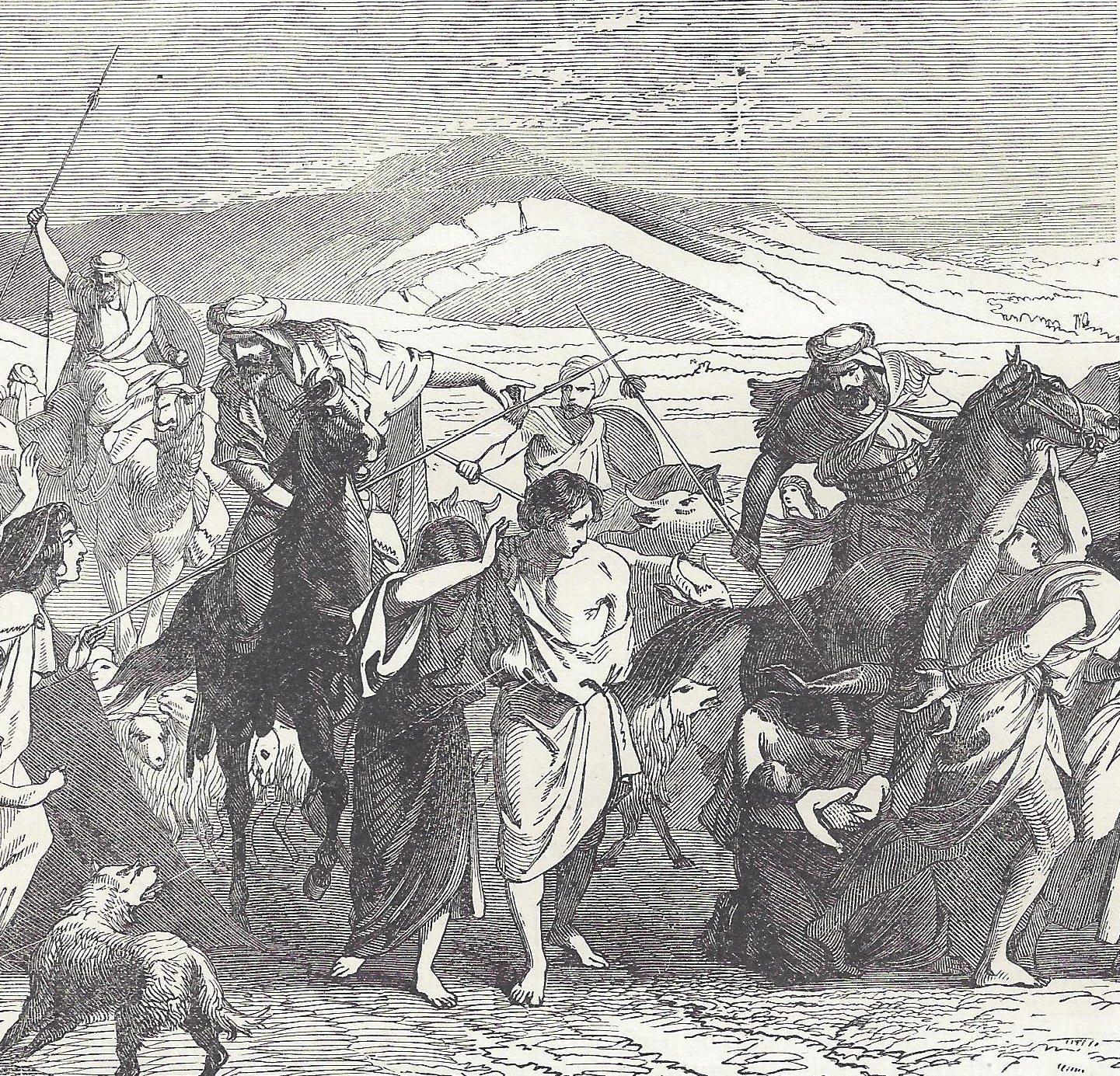 This image depicts the capture of Lot and his family, a story told in the book of Genesis.
Extension activity: Have students create a map of Lot's travels. |
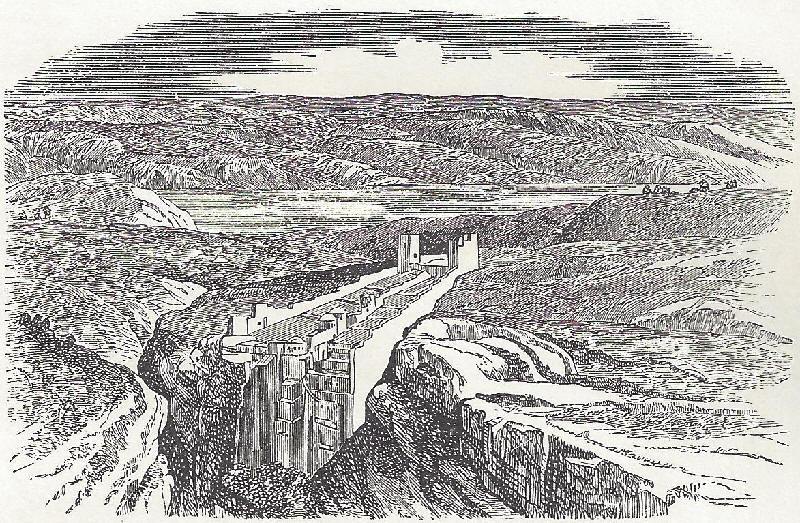 A view of the Dead Sea from the Convent of Mar-Saba in Israel, circa 1900 C.E., before many modern structures were built.
Extension activity: Ask students to identify the Dead Sea on a map or globe. |
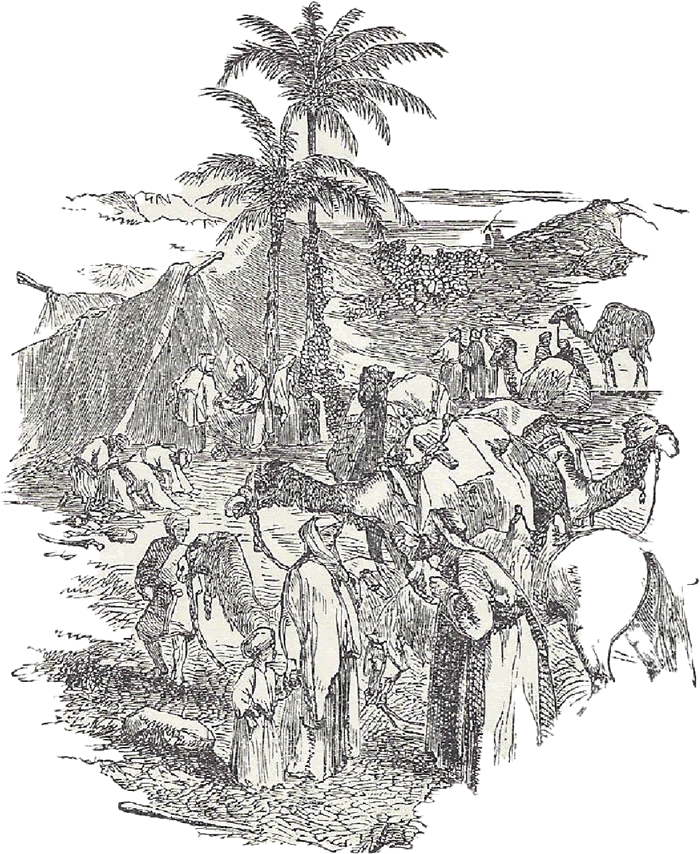 This image depicts Abraham's encampment at Mamre, near Hebron. This is where his wife, Sarah, died.
Click for the image file: JPG PNG SVG Question for students: Describe the role of Sarah in religious history. |
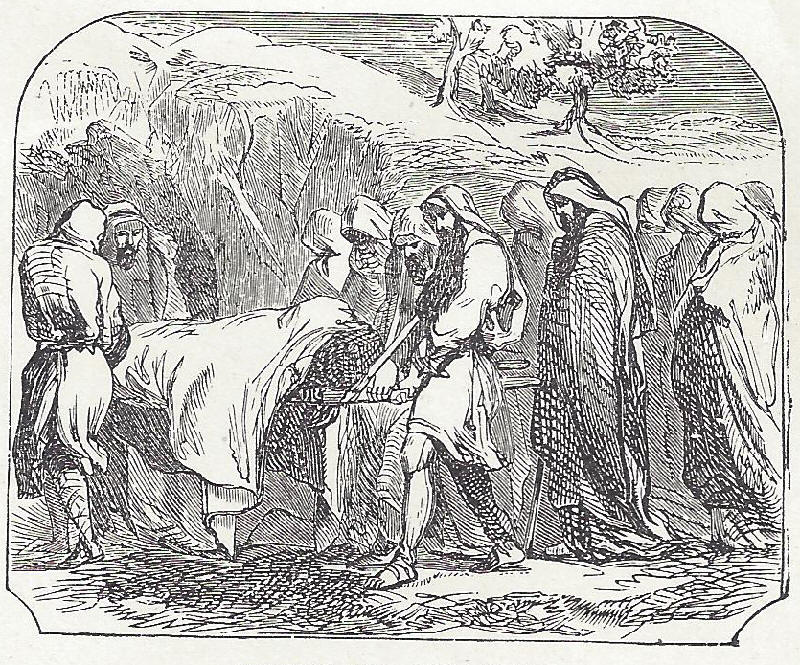 According to Genesis, Abraham died at 175 years of age. He was buried by his sons, Isaac and Ishmael, in the Cave of Machpelah.
Abraham is the foundational patriarch of Judaism, Christianity, and Islam. Born Abram in Ur, according to tradition, he answered God's call to journey to Canaan, where he received a covenant promising innumerable descendants and the land of Canaan. His unwavering faith—demonstrated by his willingness to sacrifice his son Isaac—established him as the "father of many nations" and a model of obedience. Extension activity: Have students create a Venn diagram comparing and contrasting the role of Abraham in the three principal Abrahamic religions: Judaism, Christianity, and Islam. |
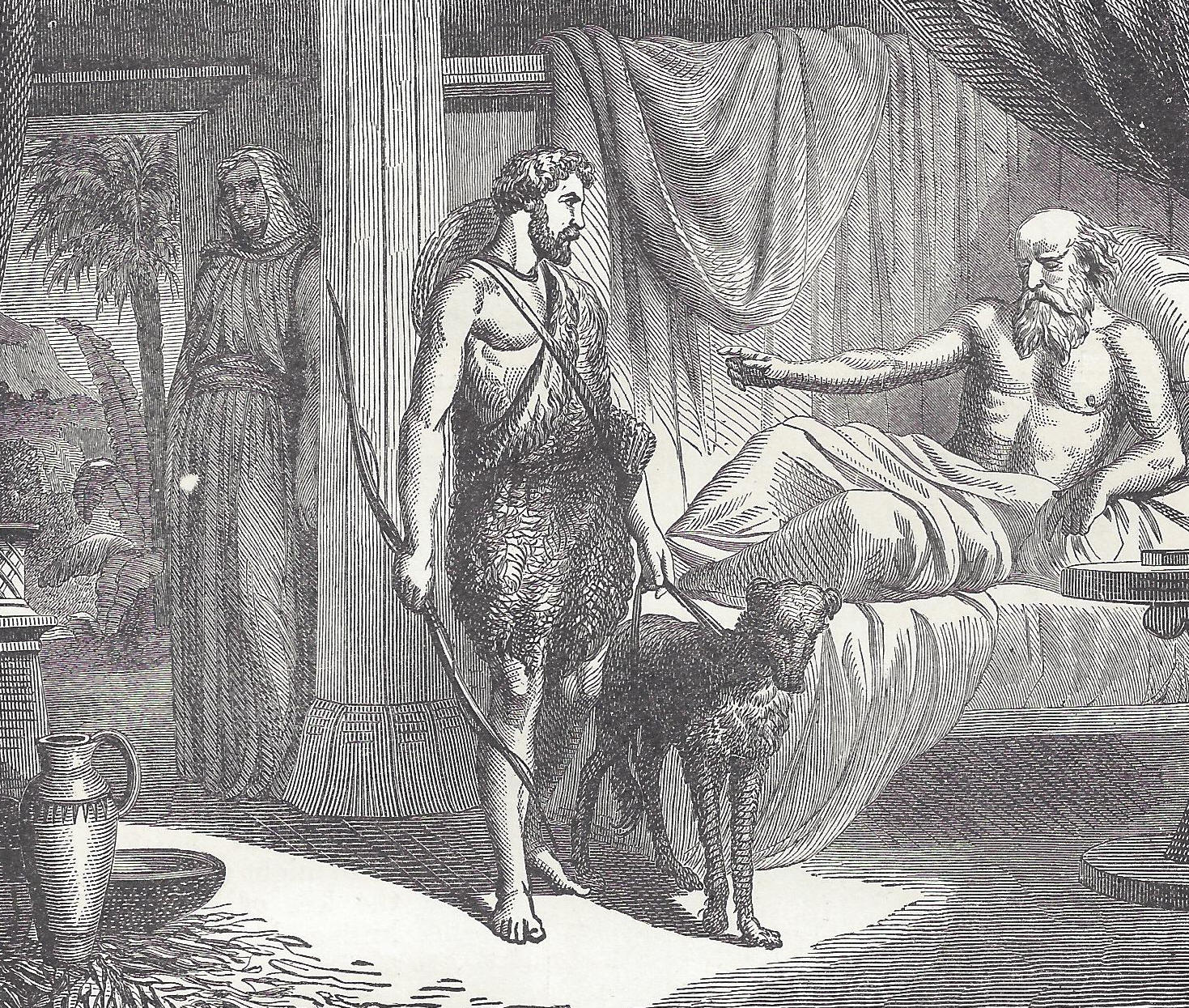 Esau is pictured telling his father, Isaac, that he will procure venison. Unbeknownst to Isaac, Esau (his favorite son) was tricked by his brother, Jacob, into giving away his birthright as Isaac's heir. Isaac's wife, Rebekah, tells Jacob (her favorite son) of Isaac's plan to anoint Esau. While Esau is away, Jacob impersonates his brother, and receives his father's blessing for himself.
Extension activity: Have students debate the ethics of Jacob and Rebekah's actions. |
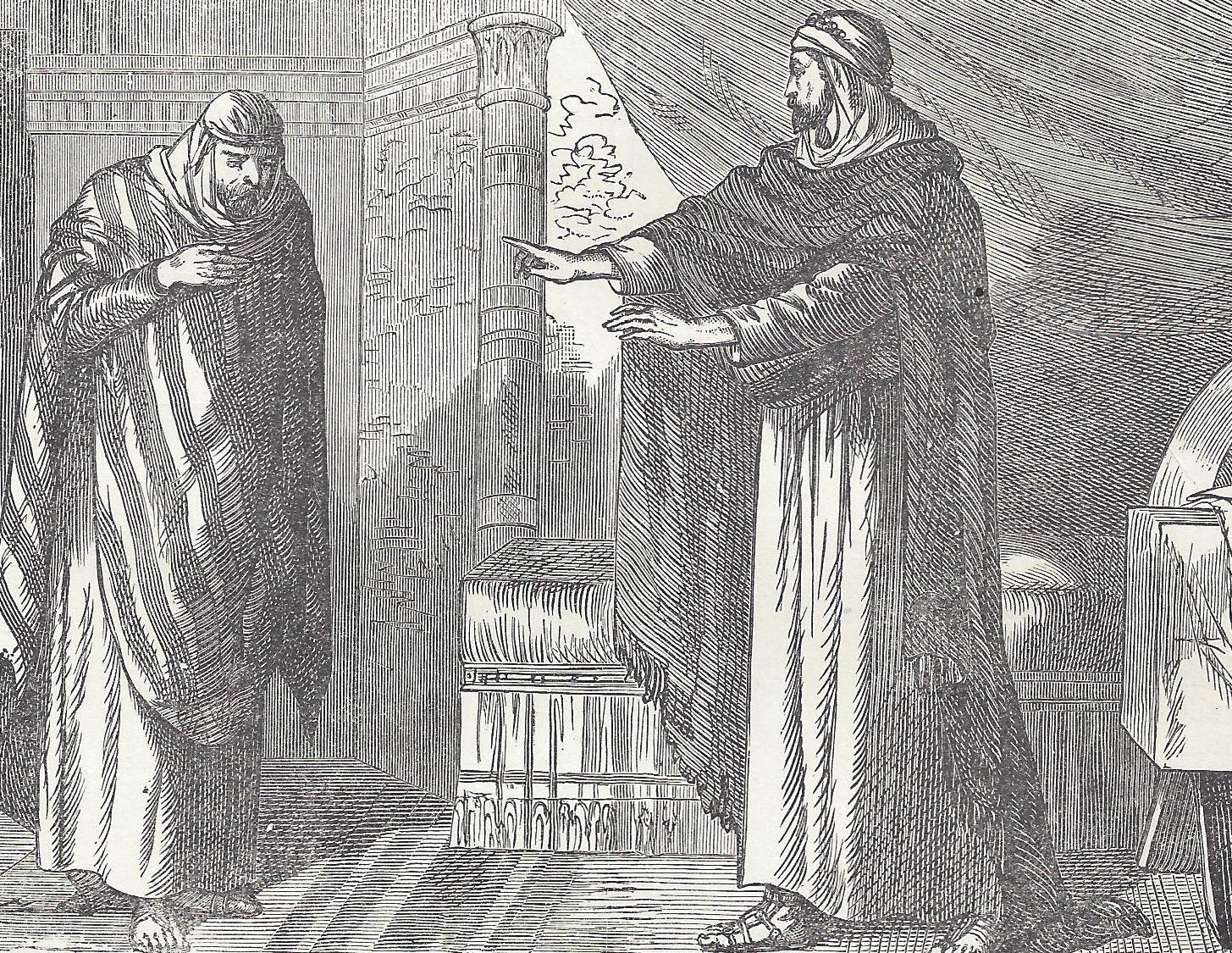 After burying his wife, Rachel, near Bethlehem, Jacob was reunited with his father, Isaac, at Mamre.
This engraving depicts their meeting. According to the Old Testament, Isaac died several years later, at the age of one hundred eighty. Jacob and his brother, Esau, buried Isaac in the cave of Machpelah. |
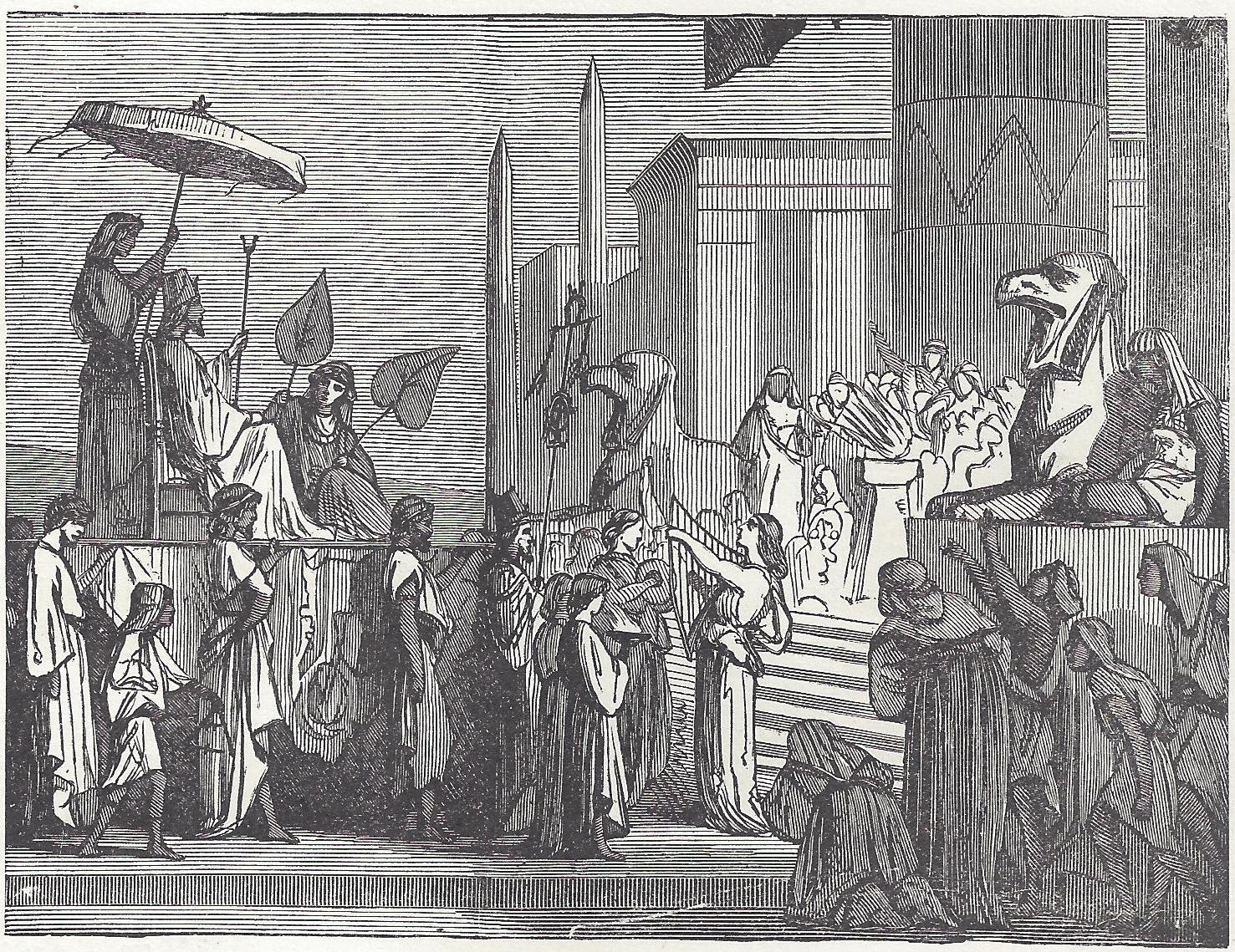 According to the Old Testament, Joseph, a son of Jacob and Rachel, was his father's favorite. Jealous of Joseph's famous "coat of many colors," the brothers feigned his death, and sold him into slavery. After many years, trials, and tribulations in Egypt, Joseph eventually arose as an important official in the pharaoh's government. Joseph foresaw a famine, and built up ample stores.
This very famine brought Joseph's brothers to Egypt to buy grain. Joseph soon enough forgave them and provided for them. The family stayed in Egypt, being granted lands in the province of Goshen by the pharaoh. This explains the presence of the chosen family in Egypt. On his deathbed, Joseph demanded that his embalmed body be entombed in Canaan only when the Israelites should leave Egypt (which was done under the later leadership of Moses). |
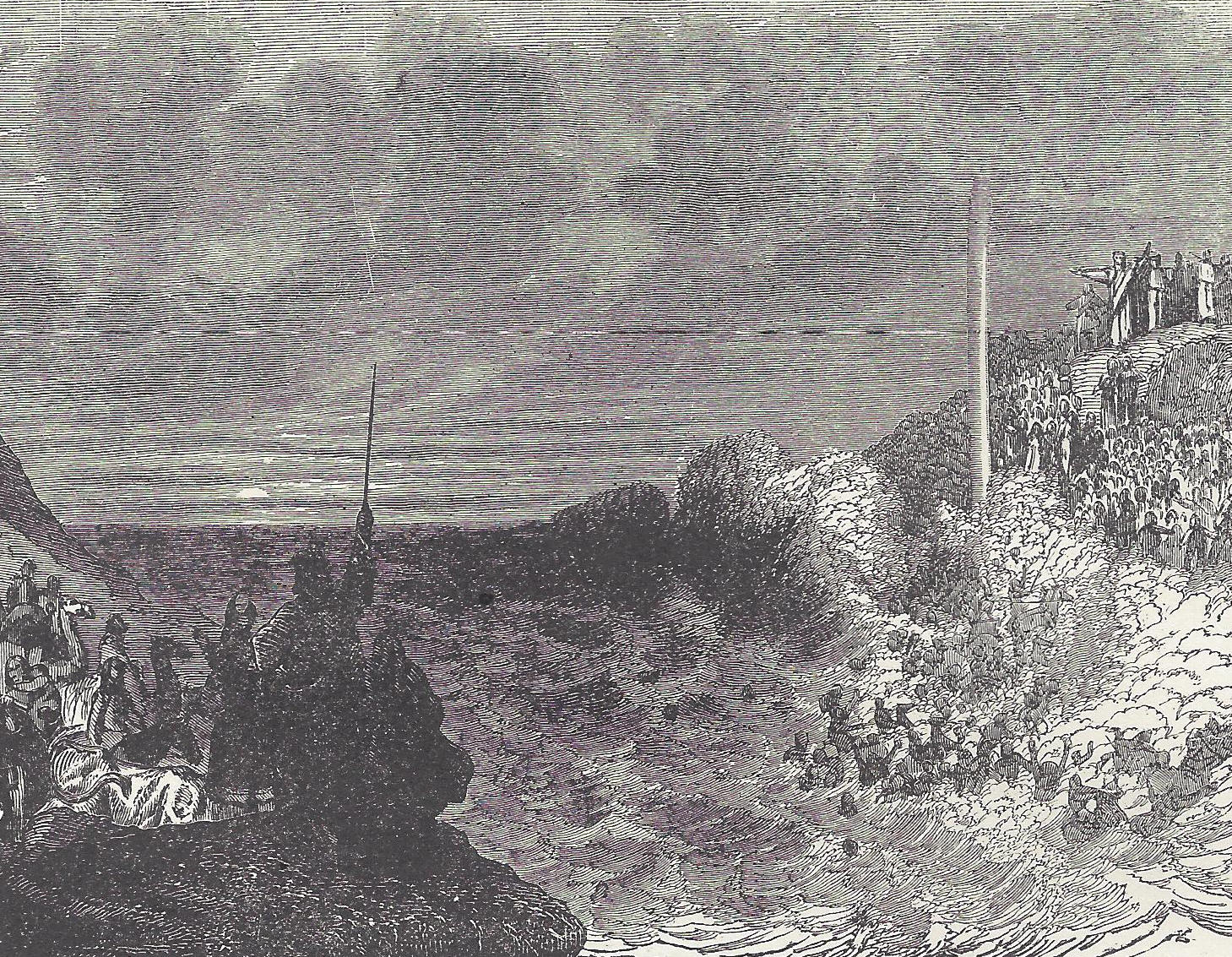 This pen-and-ink drawing illustrates the safe arrival of the Israelites, led by Moses, on the other side of the Red Sea.
Pharaoh's remaining forces can be seen to the left, still on the opposite side. The pillar of smoke guiding the Hebrews can also be seen. |
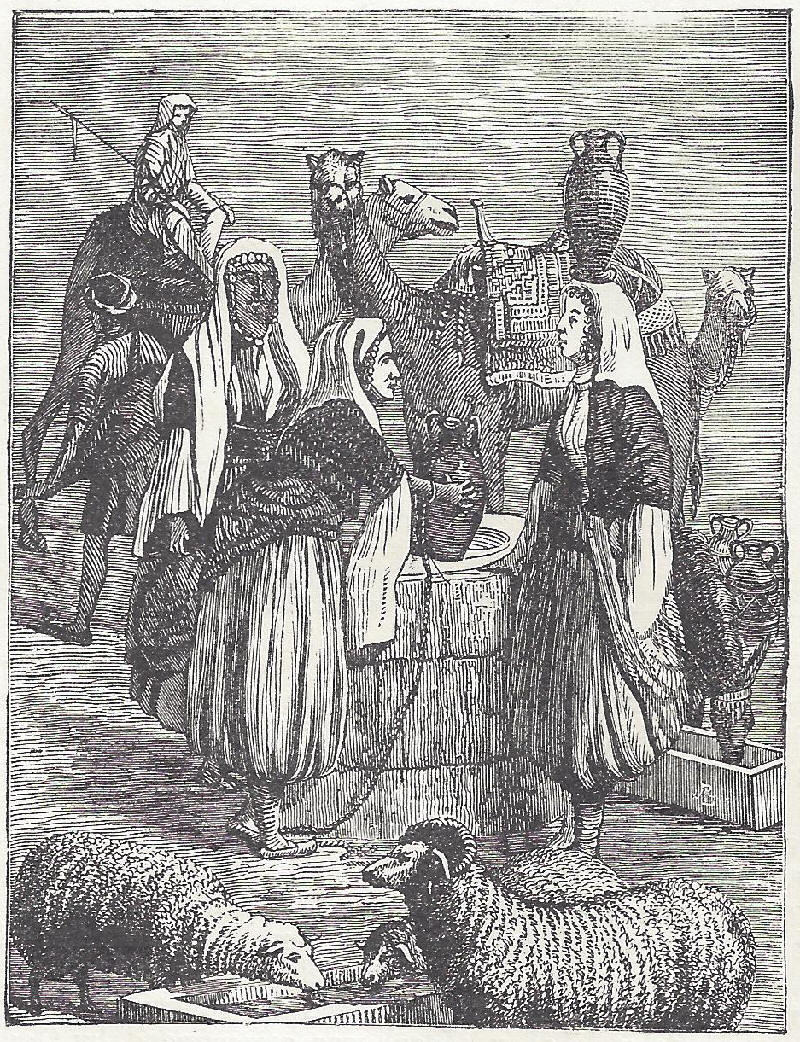 This image depicts the daughters of Laban at a well. Laban was the father of Rachel, who was the wife of Jacob.
Laban made Jacob work for him for many years before he would allow Jacob to marry Rachel. Extension activity: Have students create a family tree for Jacob and Rachel. |
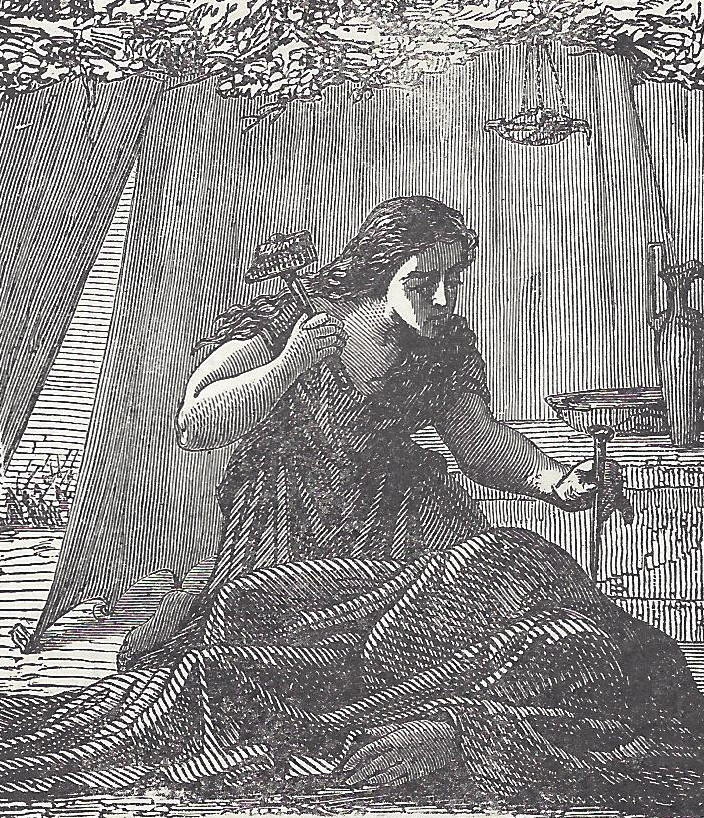 Yael or Jael (Hebrew) is a biblical character mentioned in the Book of Judges (Judaism and Christianity).
Yael was the biblical heroine who killed Sisera (commander of the Canaanite army) in order to deliver Israel from the troops of King Jabin, as prophesied by Deborah. Yael was the wife of Heber the Kenite. |
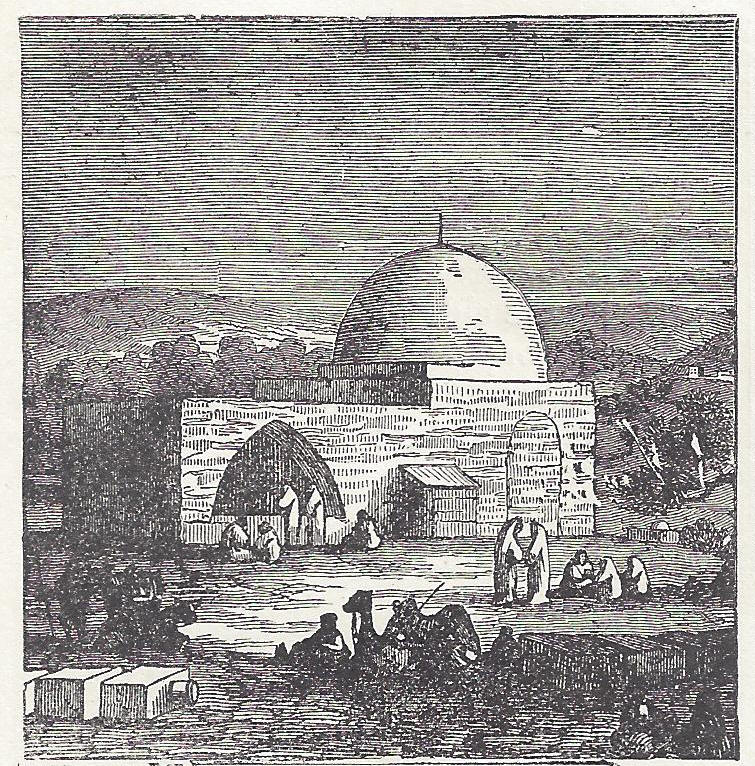 This depiction is of the tomb of Rachel, which was said to be located near Bethlehem.
Rachel was the daughter of Laban and the wife of Jacob. She died while giving birth to Benjamin. |
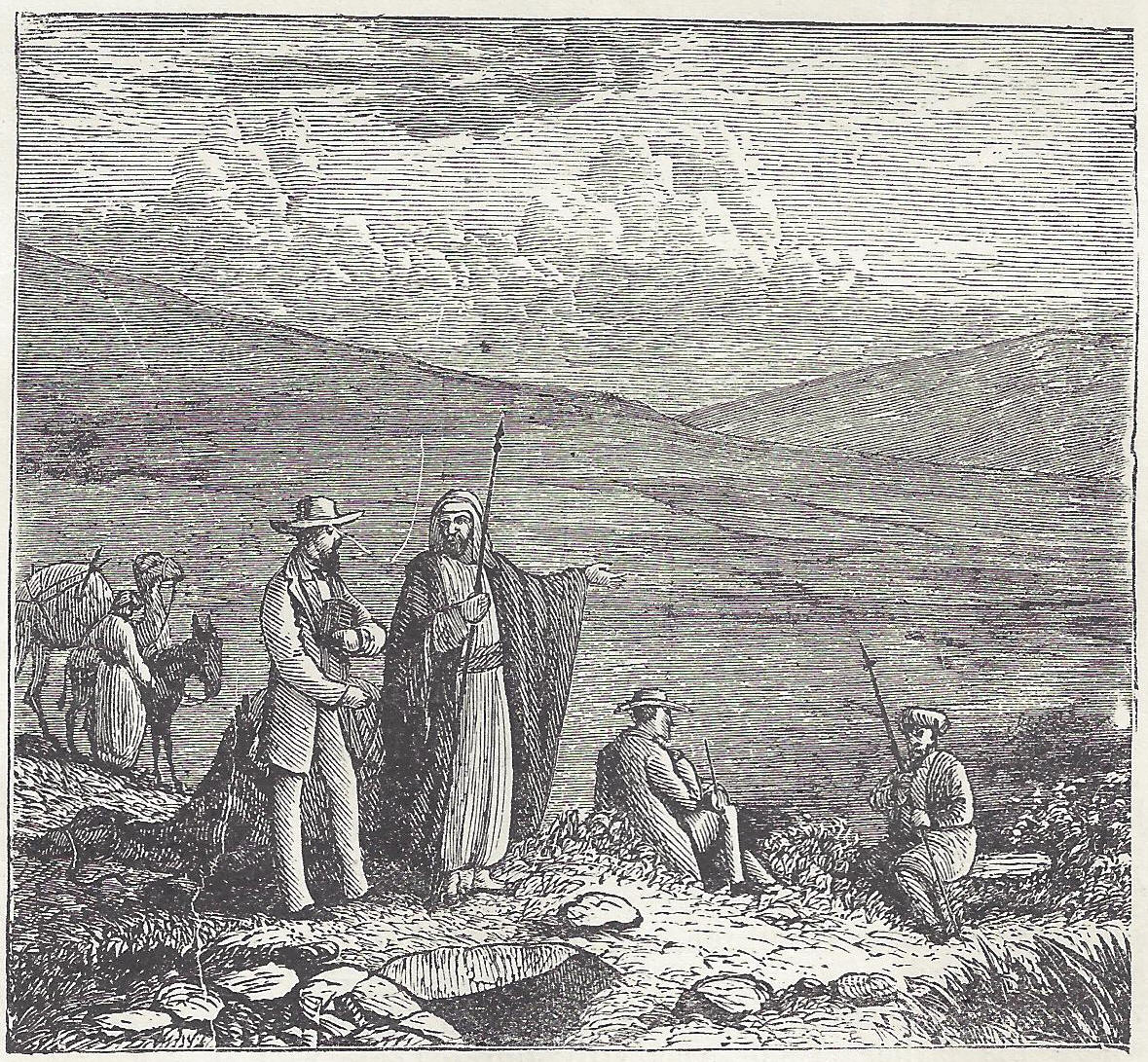 This 19th-century engraving depicts tourists visiting Jacob's well at Shechem.
Shechem was a considerable town of the Amorites. The land which Jacob bought in Shechem was the first piece of property owned by the chosen family in the promised land of Canaan. It was near this well, reportedly dug by Jacob himself, that he built an altar to God. |
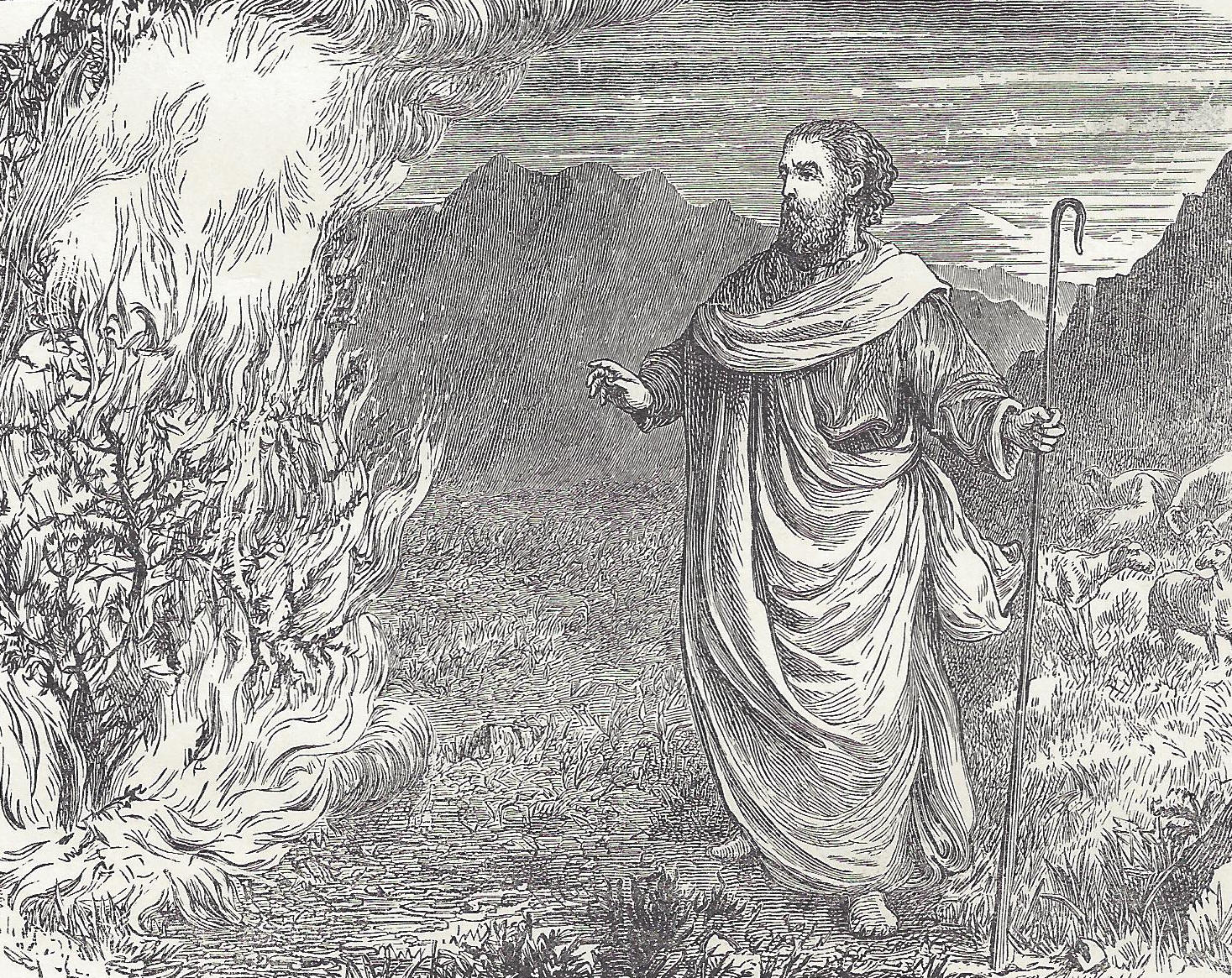 Fleeing Egypt after murdering an Egyptian, Moses took refuge on the Sinai Peninsula. After defending the daughters of Jethro, a Midianite, Moses went to live with Jethro, marrying one of his daughters, Zipporah. During the forty years that Moses spent among the Midianitish tribe, a new pharaoh came to the Egyptian throne.
While tending his flock on a remote part of Mount Horeb, Moses saw a bush that burned without being consumed. A voice came from this bush, telling Moses that he was in the presence of God. Moses was further told that he was being called upon to lead the Israelites out of bondage in Egypt. This story is told in the Book of Exodus, the second book of the Hebrew Torah and of the Christian Old Testament. The story of the flight of Moses and his quest to return is echoed in ancient Egypt's Tale of Sinuhe, which dates as far back as the twentieth century B.C.E. |
 In order to prove that he was sent by God, Moses turned his staff into a snake for pharaoh.
Pharaoh's priests did the same, but Moses' serpent ate theirs up. Moses was accompanied by his brother, Aaron. |
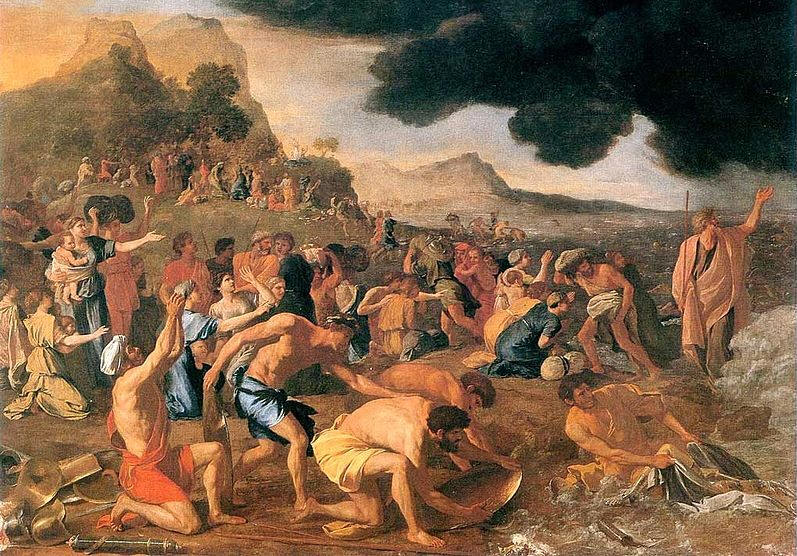 Crossing of the Red Sea by Nicolas Poussin (1634) depicts Moses parting the waters of the Red Sea so that the Israelites can flee from pharaoh's forces during the Hebrew exodus from Egypt.
The story of the parting of the Red Sea is similar to a tale told in ancient Mesopotamian creation mythology. |
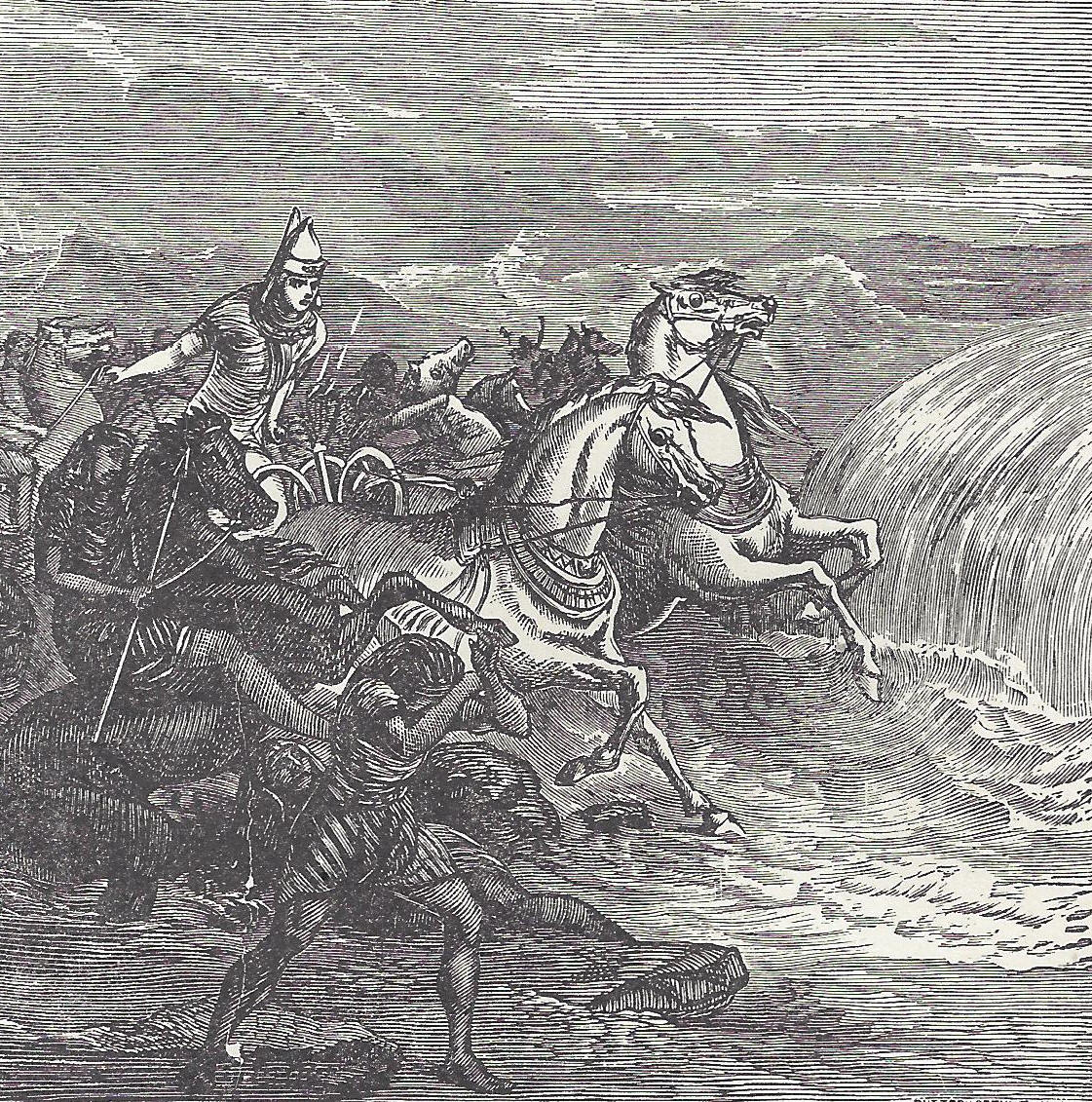 This image depicts the biblical account of the destruction of the Egyptian pharaoh's army at the Red (or Reed) Sea.
The waters had been parted by Moses in order that the Israelites might cross. Once the Hebrews were safely on the opposite shore, the waters returned, drowning the Egyptian troops. Extension activity: Ask students to chart the course the Israelites are said to have taken as they left Egypt. |
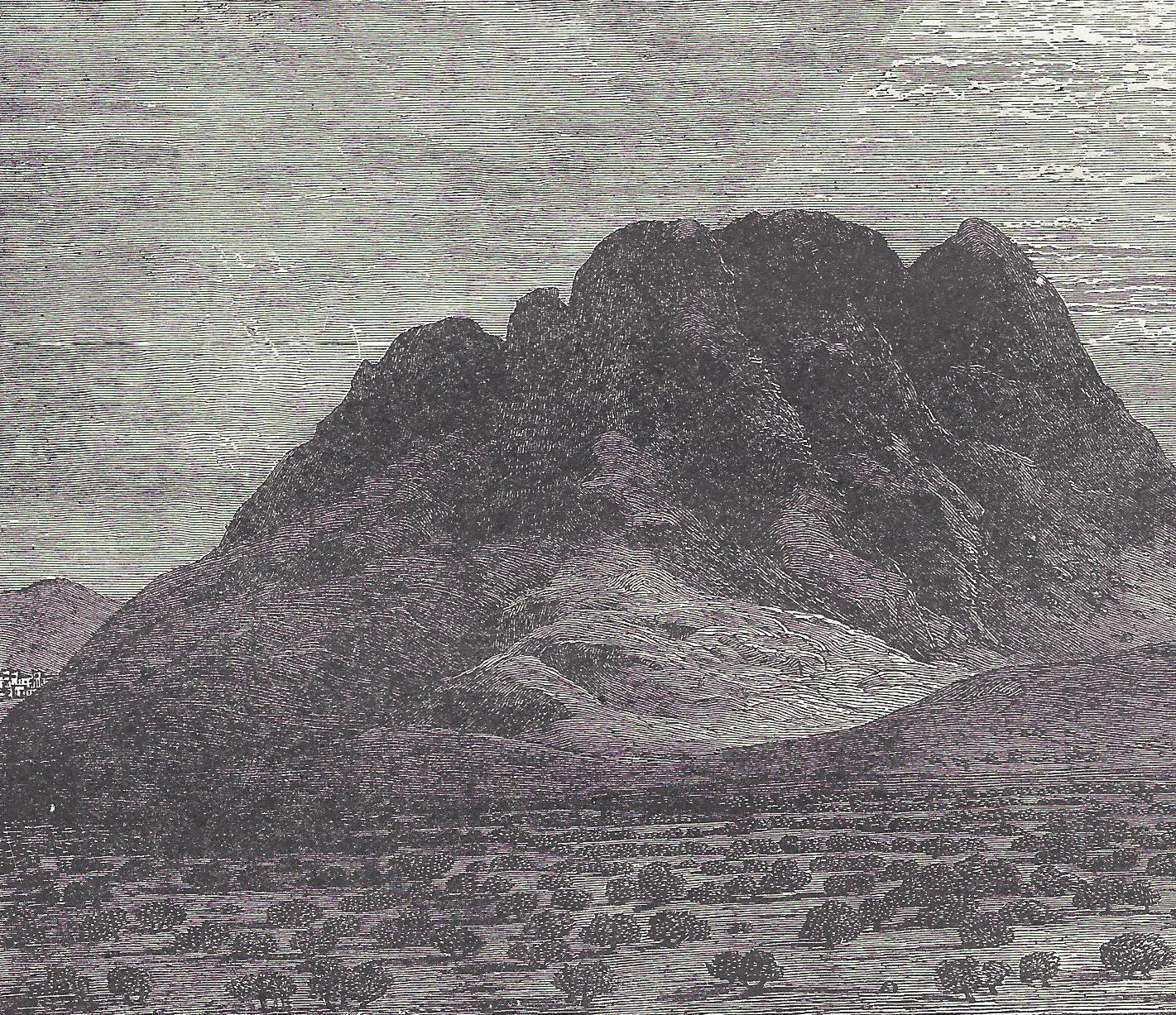 This pen-and-ink drawing depicts Mount Sinai as seen from the plain of Er-Rahah.
According to the Book of Exodus, it was on Mount Sinai that Moses received the Ten Commandments from God (Yahweh). Extension Activity: Task students with locating Mount Sinai on a map or globe. |
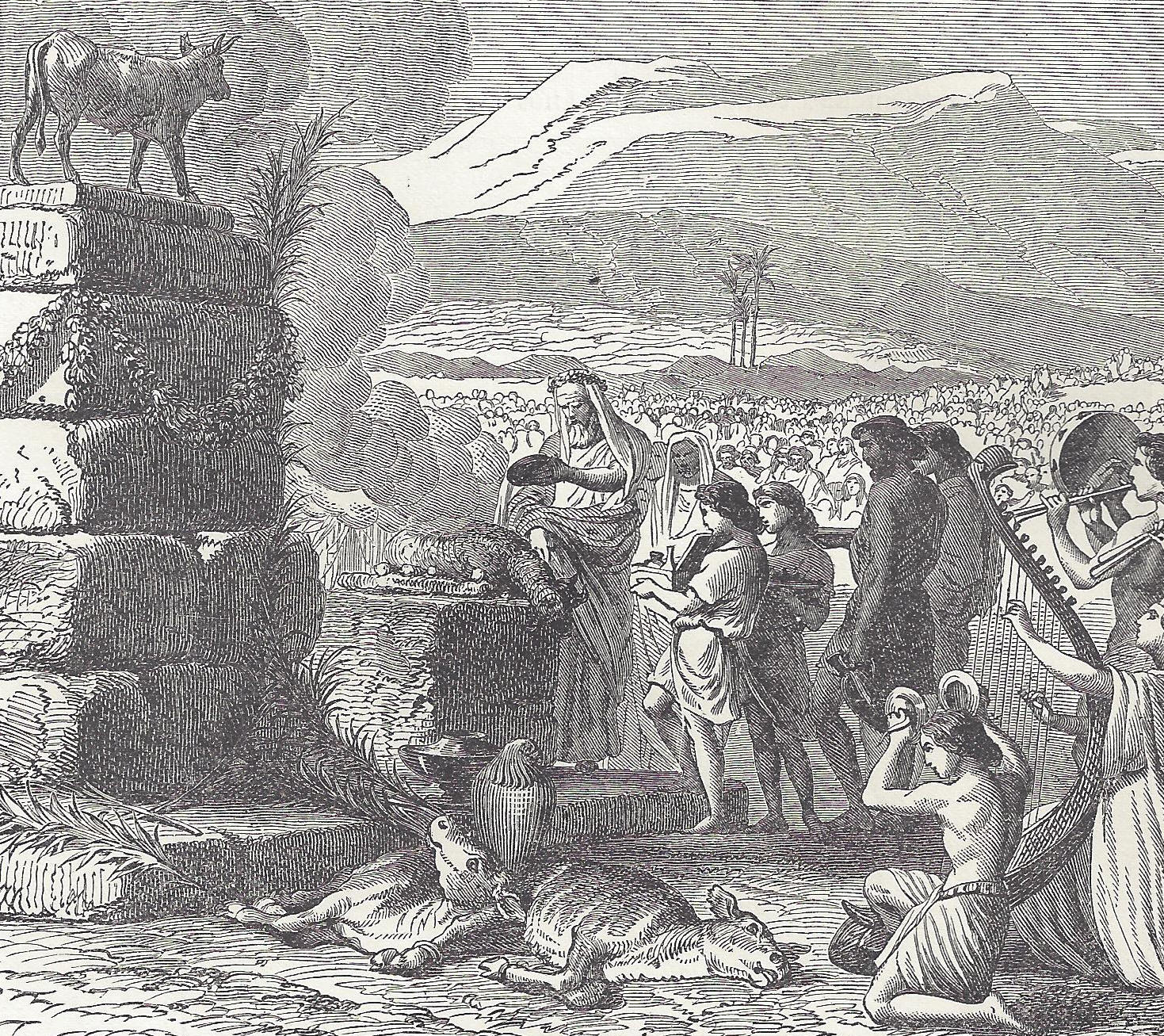 While Moses was atop Mount Sinai receiving the Ten Commandments, the Israelites grew restless.
After much pleading, they were able to get their high priest, Aaron (brother of Moses), to commit an animal sacrifice to a golden calf they had made. |
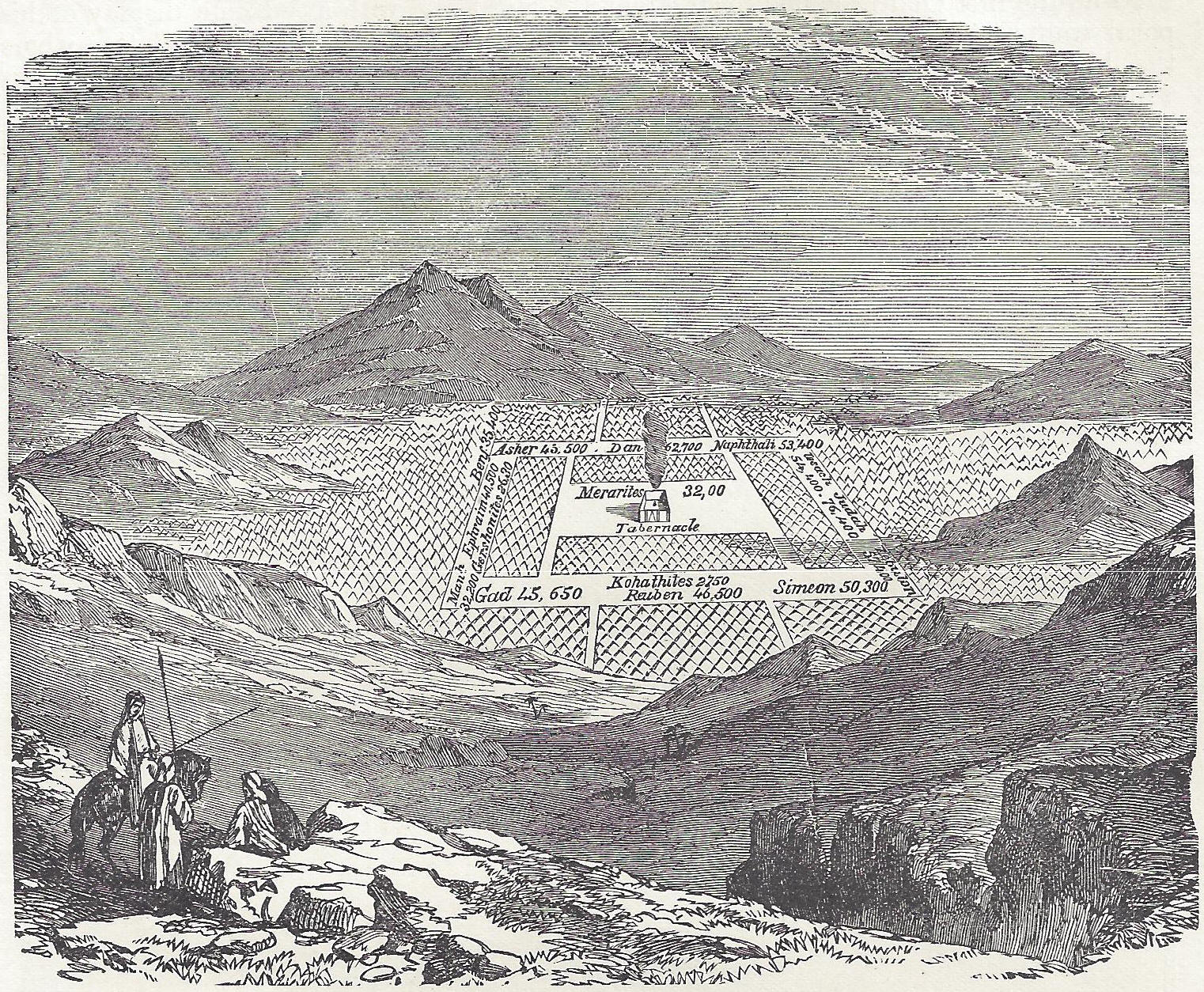 This drawing illustrates the plan for the Israelite camp in the wilderness, under the leadership of Moses.
The tribe of Asher allegedly numbered 45,500; Dan, 62,700; Naphthali (or Naphtali), 53,400; Benjamin, 35,400; etc. The tabernacle, with Aaron (the brother of Moses) serving as high priest, was located in the center of the encampment. |
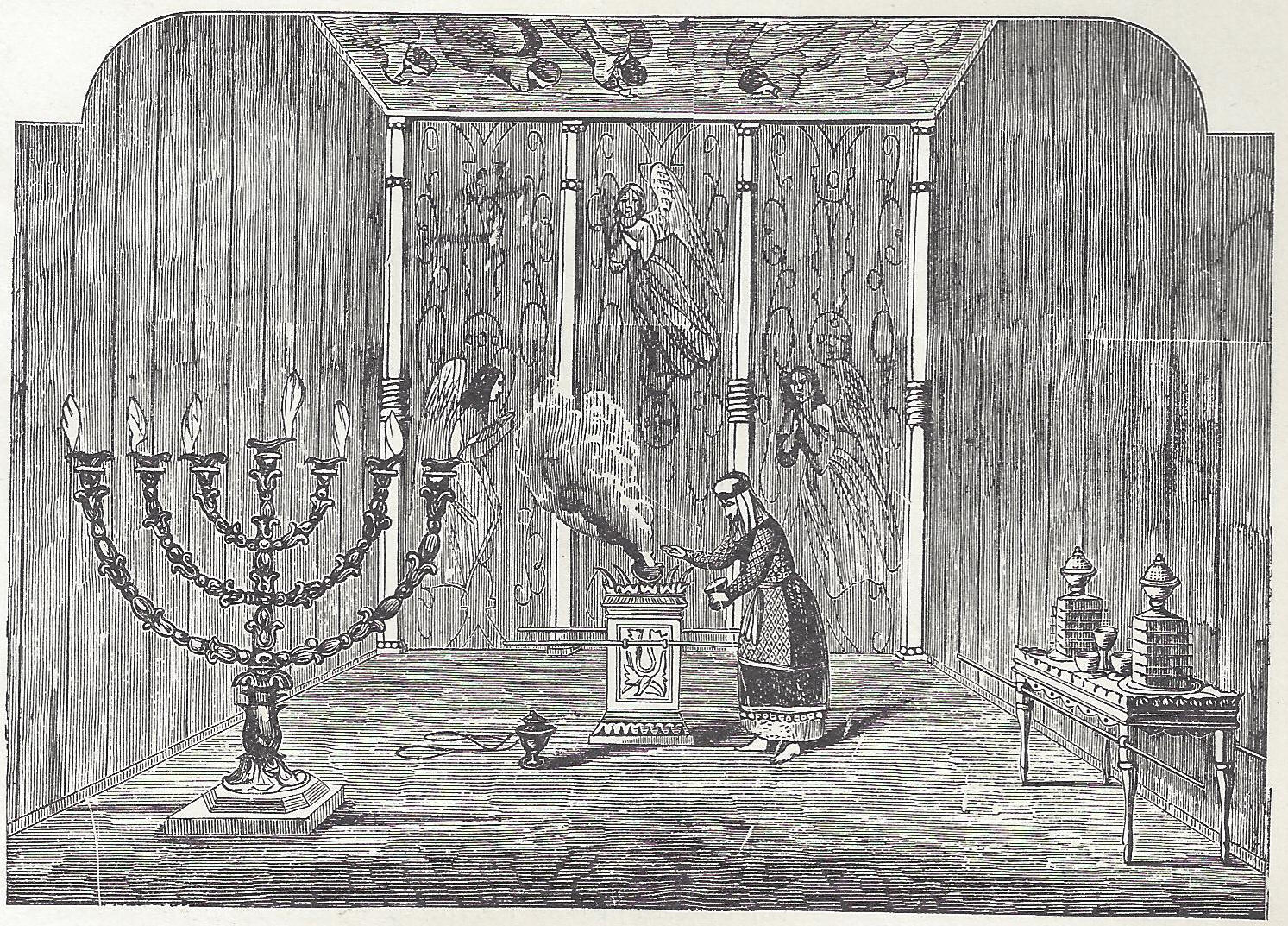 This picture illustrates the Holy of Holies, the holy place in the Sinai wilderness Tabernacle (sacred tent) of the Israelites.
It was during this time spent at Sinai (eleven months, twenty days) that the Hebrew priesthood and ceremonial procedures were firmly established. |
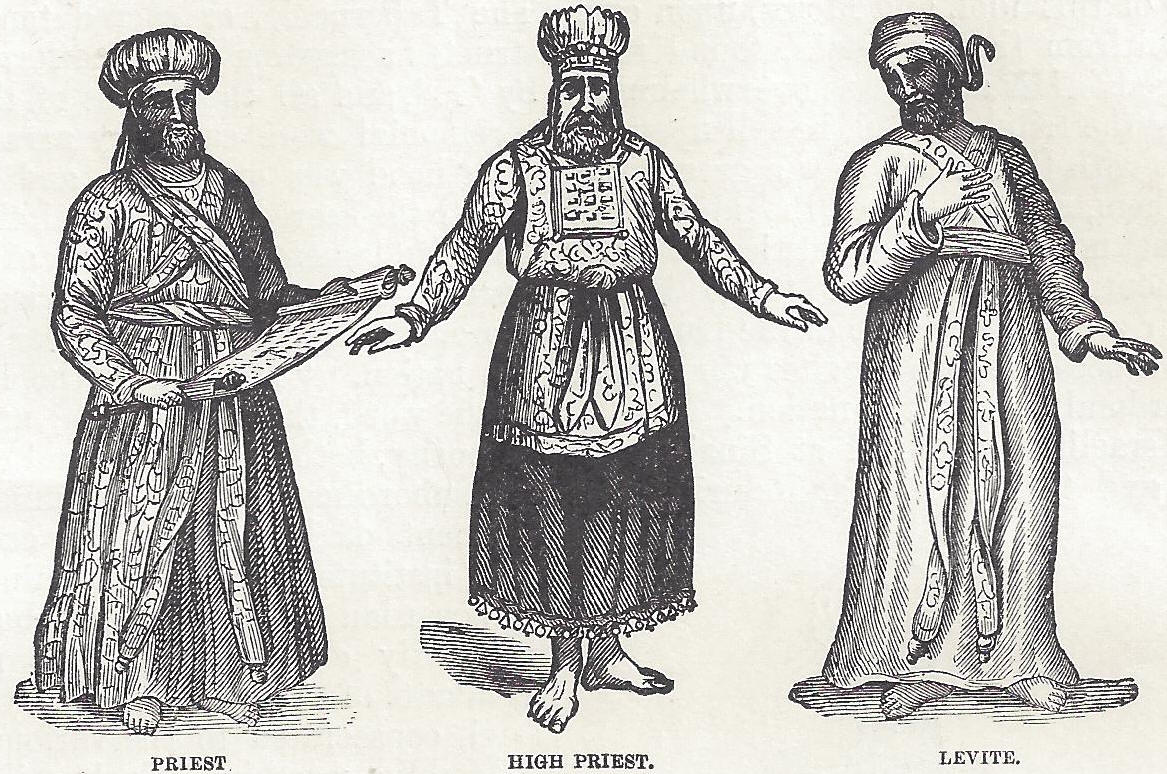 Above are illustrated a priest, high priest, and Levite of the Hebrews of Torah times. A priest (kohen) had to descend from Aaron. The first high priest was Aaron, after which the position was to pass to his eldest son, then to his eldest son, ad infinitum (this practice was followed in early Judaism, but altered during later years as the Israelites came to be ruled by foreign powers).
Once in Israel, the Levites (the tribe of Levi, to which Moses and Aaron belonged) were not given land, as they were to perform religious functions for Hebrews throughout Israel (in exchange for which, members of this tribe were paid a tithe; this tithing is still observed among many Orthodox and Hasidic Jews). Interestingly, modern DNA research has discovered the Cohen Modal Haplotype (CMH), linked back to a person researchers refer to as Y-chromosomal Aaron (after Aaron, the brother of Moses, and as a nod to the Y-chromosomal Adam haplotype famous in archaeogenetics). Further research has revealed that about half of today's Jewish kohanim share a close common ancestor, with 15% of them even more closely related. Although modern science cannot state that this ancestor was the biblical Aaron, it does show that despite the thousands of years that have passed since the Jewish priesthood was organized, a remarkable job appears to have been done at observing the lines of patrilineal descent. |
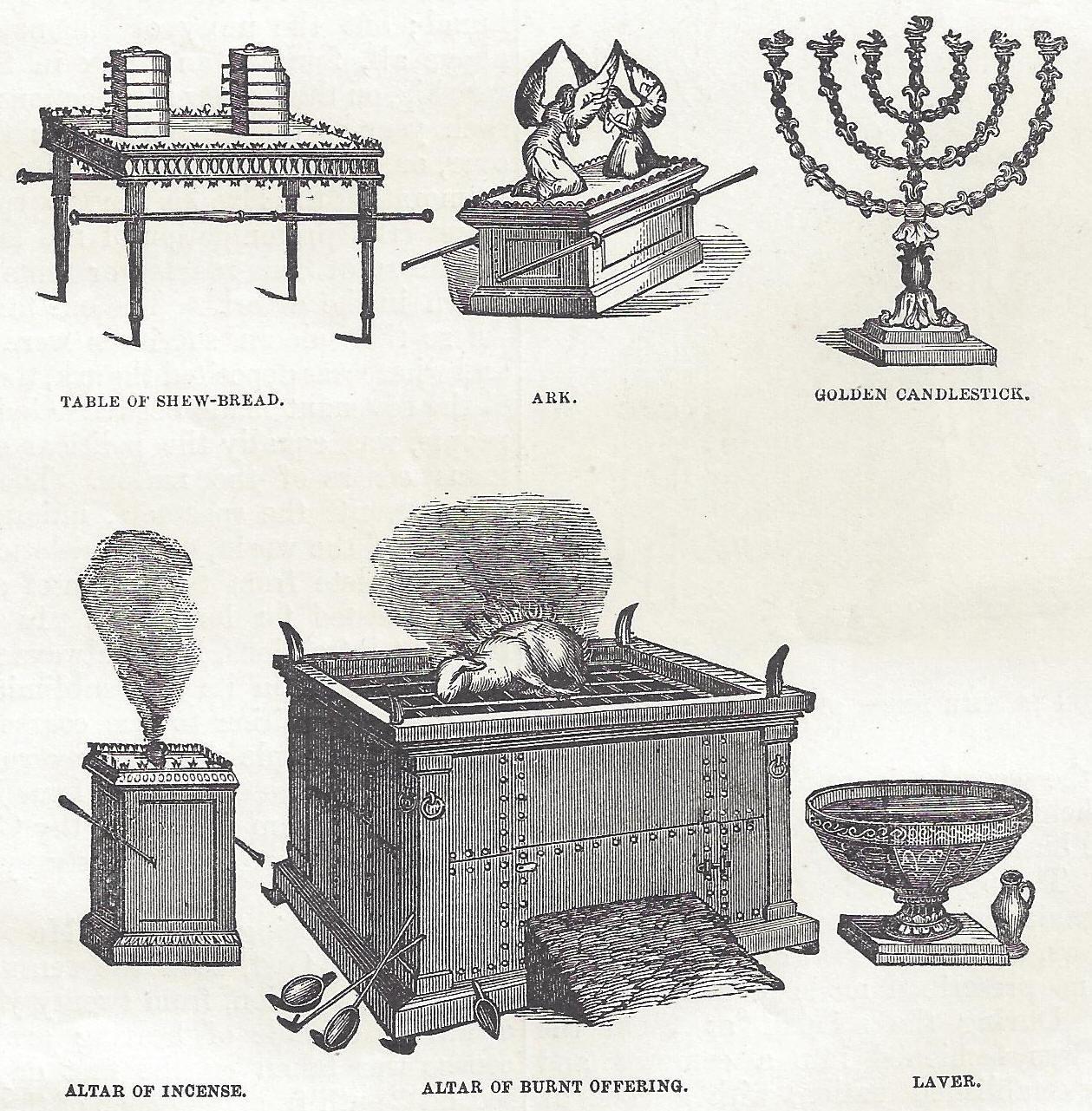 Pictured are religious items of the ancient Hebrews, used in the Sinai Tabernacle and later at the Jerusalem Temple.
Shown are the table of shewbread (or showbread), the Ark of the Covenant, the golden candlestick (menorah) made of solid gold, the altar of incense, the altar of burnt offering, and the laver (water basin for ritual purification). |
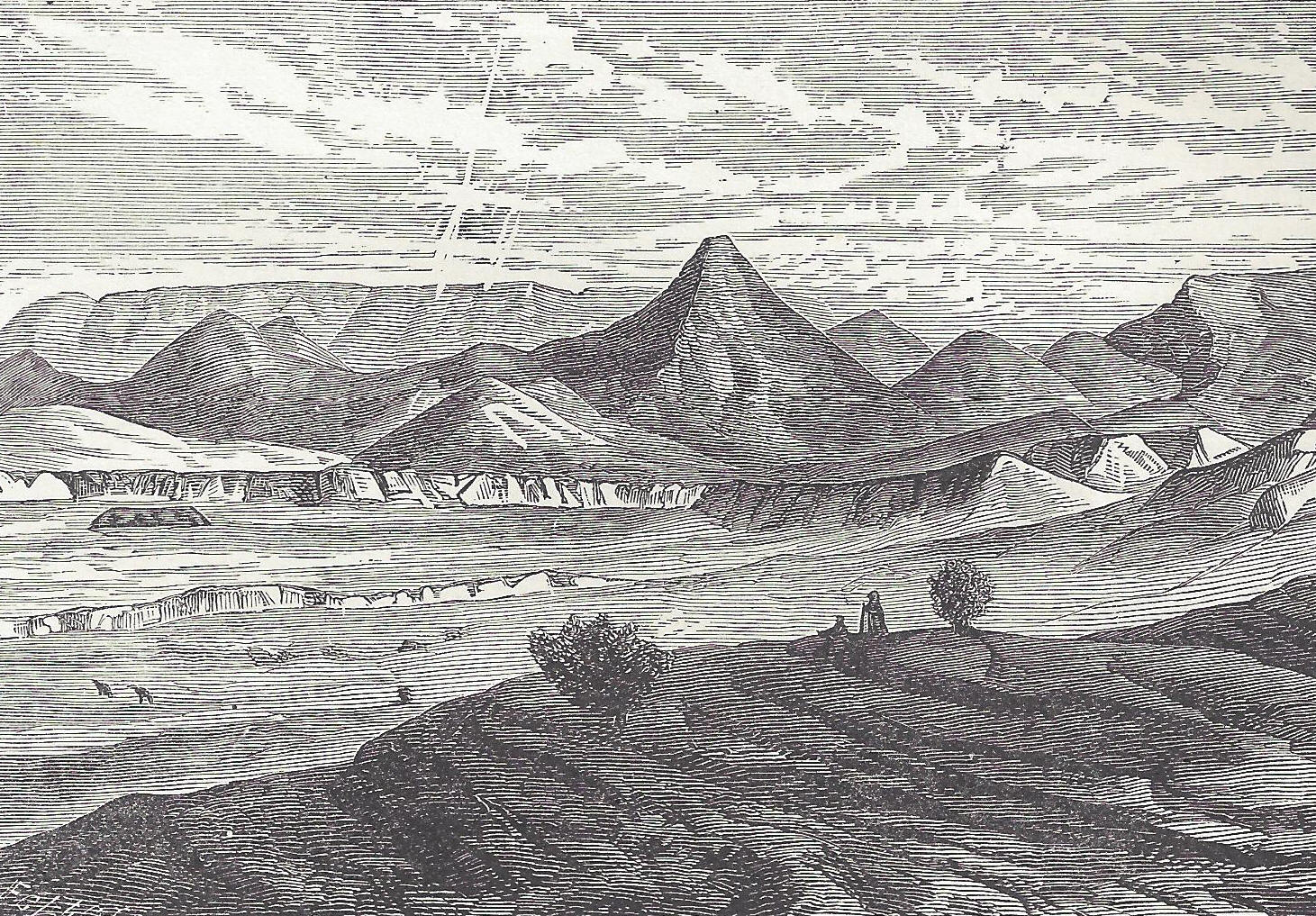 This picture depicts the wilderness of the wanderings as it likely appeared during the biblical era.
According to the Bible, the Israelites, led by Moses out of Egypt, were condemned to wander through the desert for forty years before entering Canaan (Palestine). |
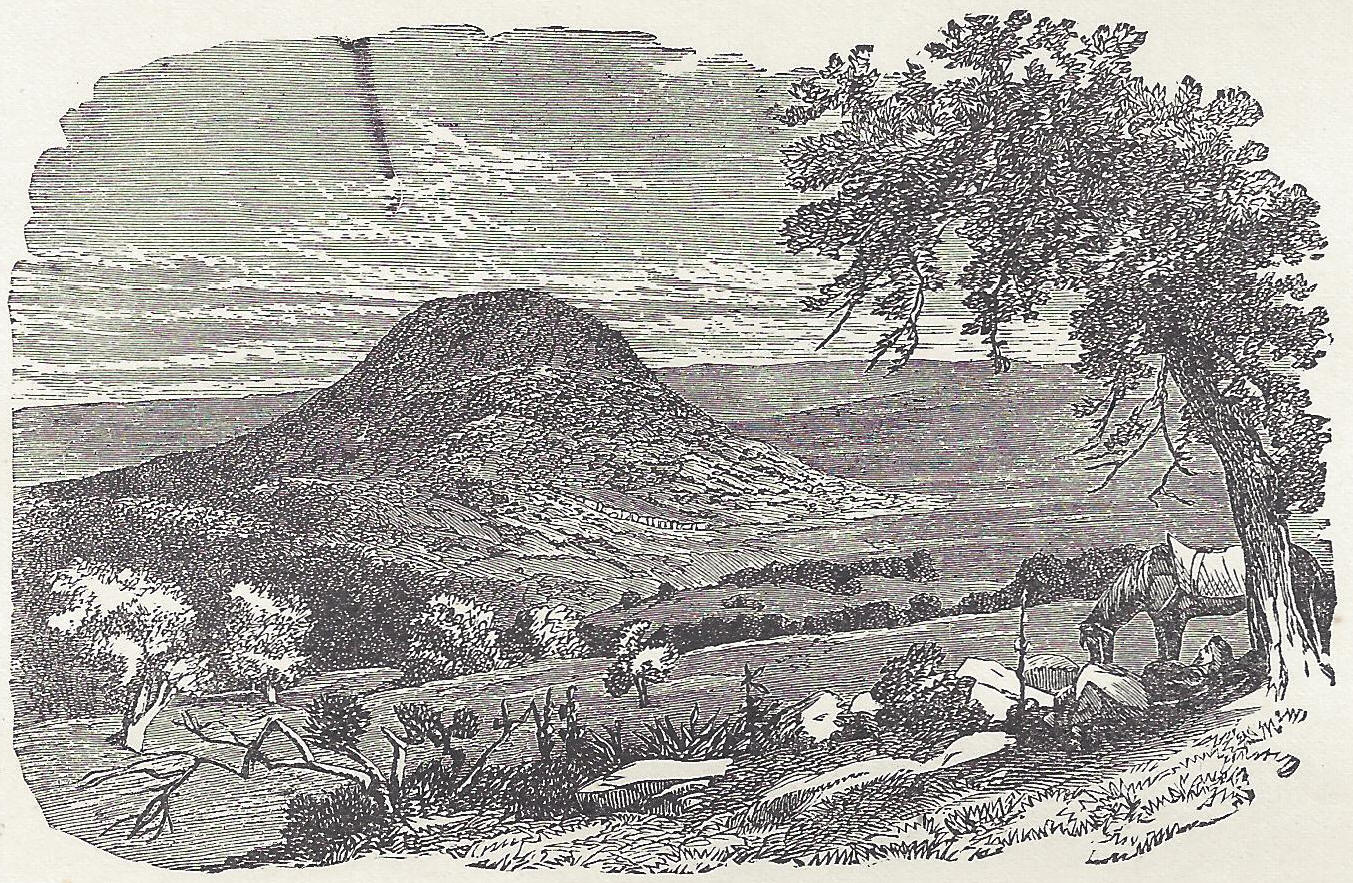 Mount Nebo was located just outside of Canaan.
It was here that Moses sat on the mountaintop and saw the Promised Land before he died. |
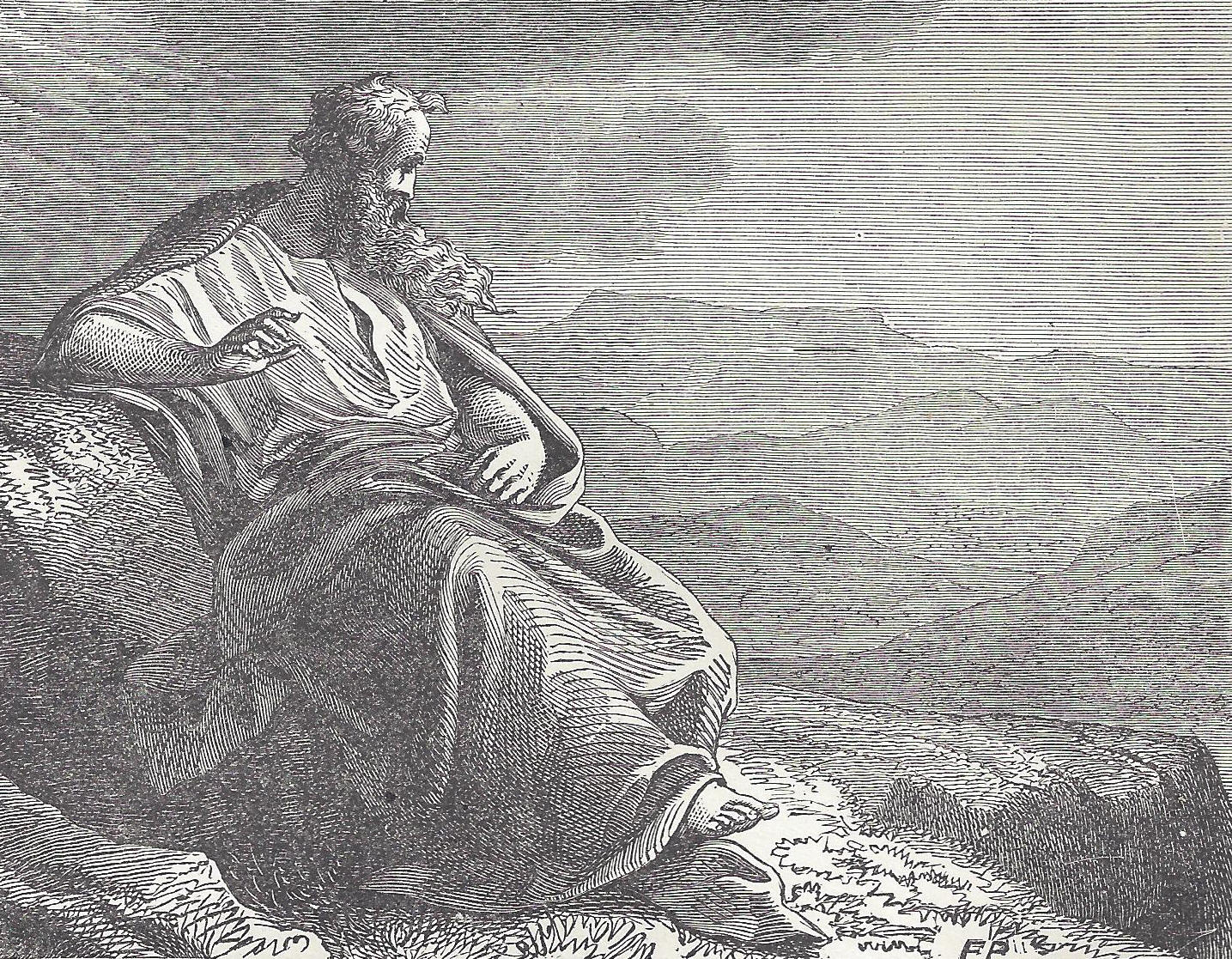 This pen-and-ink drawing illustrates Moses viewing the Promised Land of Canaan (Palestine) from atop Mount Nebo.
After passing the leadership of the Hebrews to Joshua, it is said that Moses climbed Mount Nebo at God's command. There he died, and was buried in a valley of the land of Moab. The Israelites spent thirty days mourning the death of Moses. |
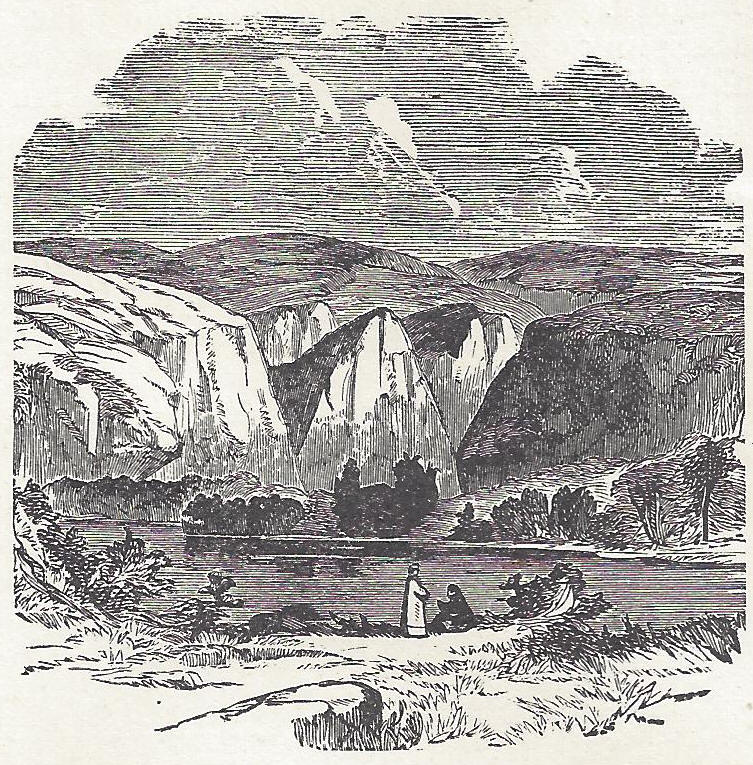 This drawing depicts a scene along the Jordan River in ancient times.
The Jordan River is 156 miles (251 kilometers) in length. Its source is in the Golan Heights, and it flows into the Dead Sea. According to Christian beliefs, Jesus was baptized in the Jordan River by John the Baptist. |
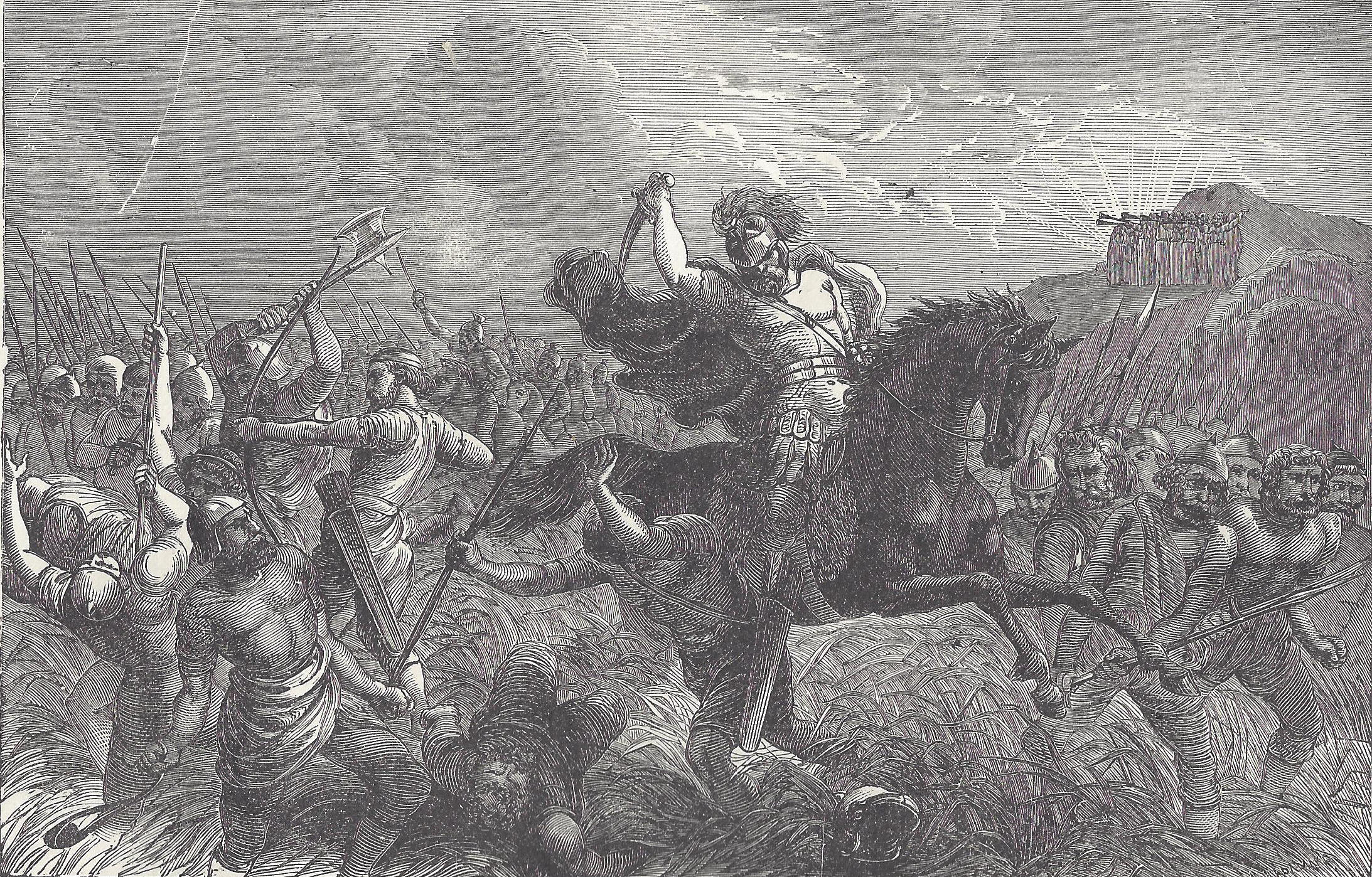 This drawing illustrates Joshua at the Battle of Beth-horon (or Bethoron), not to be confused with the Battle of Beth Horon of 166 B.C.E. (part of the Jewish Maccabean Revolt) or the Battle of Beth-horon of 66 C.E. (part of the First Jewish-Roman War).
Following the conquest of Jericho, the Canaanite kings formed a coalition to defeat the Israelites. Joshua defeated these kings at the Battle of Bethoron. According to the Old Testament, the day was miraculously prolonged in order that the Israelites could complete their victory. The Canaanite kings were taken prisoner and later hanged. More Hebrew victories quickly followed, over the cities of Makkedah, Libnah, Lachish, Eglon, Hebron, and Debir. The Bible states that all of the inhabitants of these cities were exterminated. These successes made the Israelites masters of southern Palestine. Extension activity: Classrooms can create a timeline for events in the life of Joshua. |
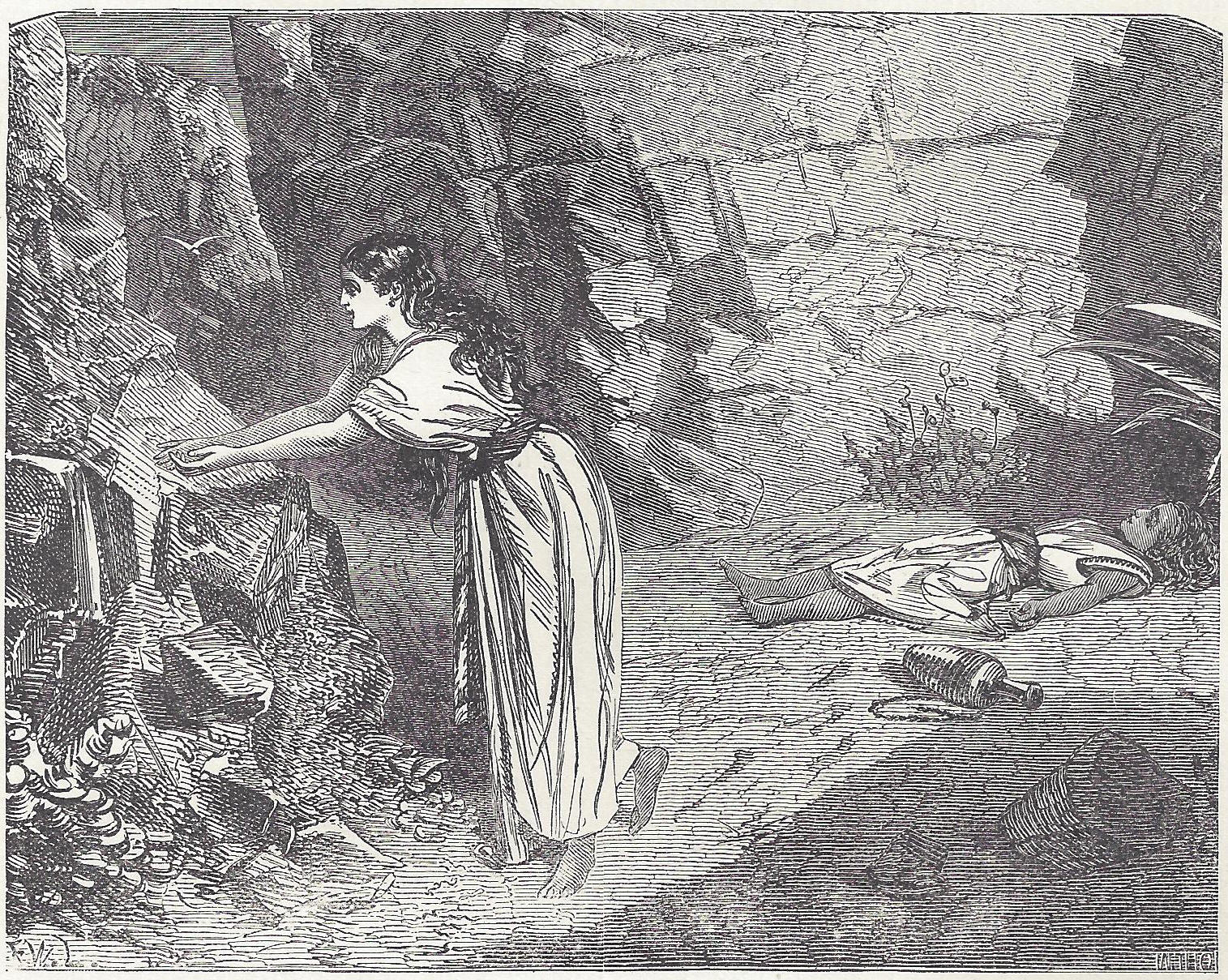 According to Abrahamic religious tradition, Sarah coerced Abraham to send away Hagar and her son, Ishmael (fathered by Abraham). Hagar and Ishmael were sustained by God in the desert, and Ishmael went on to father the Arab peoples. A version of this story is also told in Islam's holy book, the Koran.
Extension activity: Task students with comparing and contrasting the lives of Ishmael and Isaac using a relationship graphic organizer. |
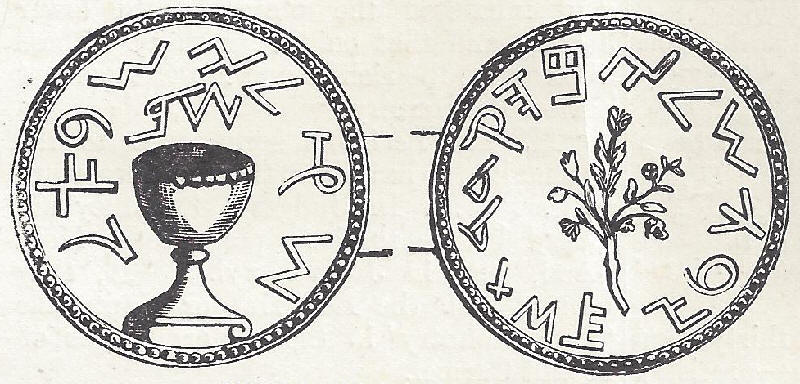 The shekel of the sanctuary was the sacred shekel because it stood as the standard weight for all other shekels. It was housed in the Tabernacle and later in the Jerusalem Temple.
"And all thy valuation shall be according to the shekel of the sanctuary: twenty gerahs shall be the shekel" (Leviticus 27:25). Correct weights and measurements were important to the ancient Hebrews, due to biblical commandments to be honest and correct with all dealings and payments. The term shekel is designated for a coin used today in Israeli currency, containing 100 agorot. Although currency valuations fluctuate, one modern Israeli shekel (or New Sheqel) is roughly equivalent in value to one U.S. quarter. |
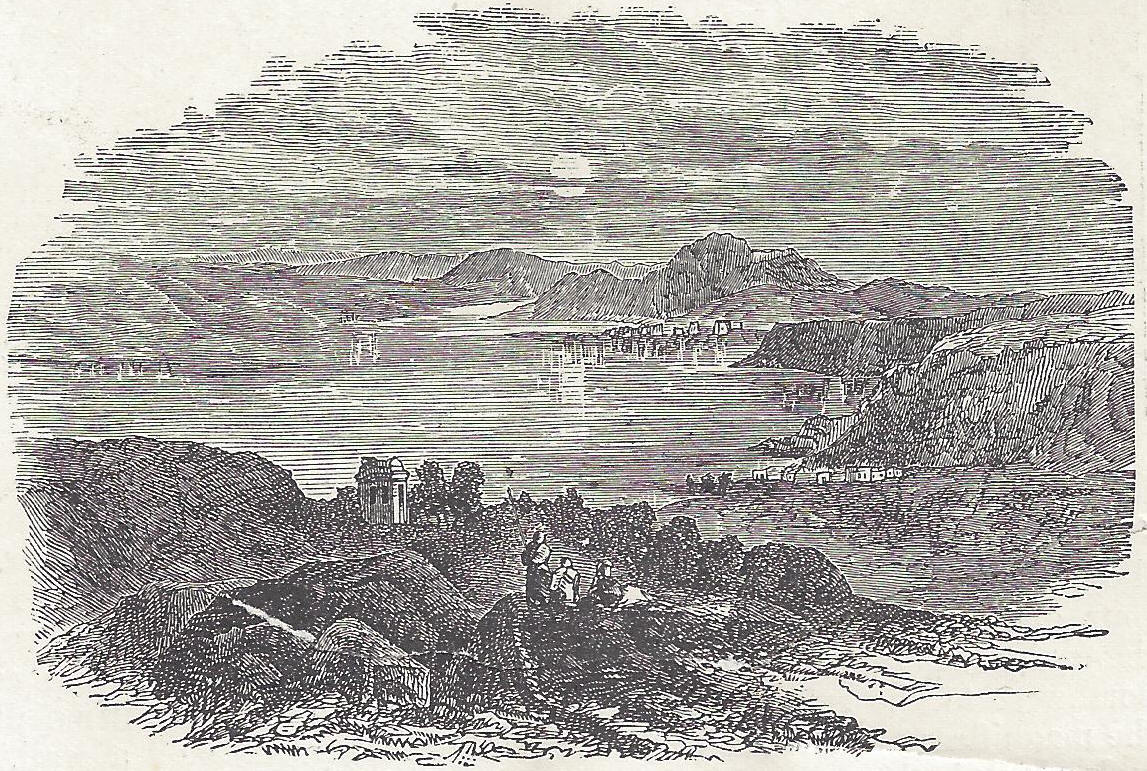 This shows a view of the Sea of Galilee from the northwest coast. The Sea of Galilee has also been called the Sea of Kinneret (or Chinnereth or Chinneroth), Lake Tiberias, and the Lake of Gennesaret. It is Israel's largest freshwater lake, measuring 33 miles (53 kilometers) in circumference. At 693 feet (211 meters) below sea level, it is the lowest freshwater lake on earth. Because of its prominence in the life of Jesus, the Sea of Galilee has been a major tourist destination for more than 1,500 years.
According to the Christian New Testament (the gospels of Luke, Mark, and Matthew), it was along the shores of the Sea of Galilee that Jesus recruited the disciples Andrew, James, John, and Simon. The famous Sermon on the Mount is said to have been told on a hill that overlooks the Sea of Galilee. Furthermore, it was on or near the Sea of Galilee that Jesus is said to have miraculously delivered a boatload of fish to his disciples, fed 5000 people, walked on water, and calmed a storm. |
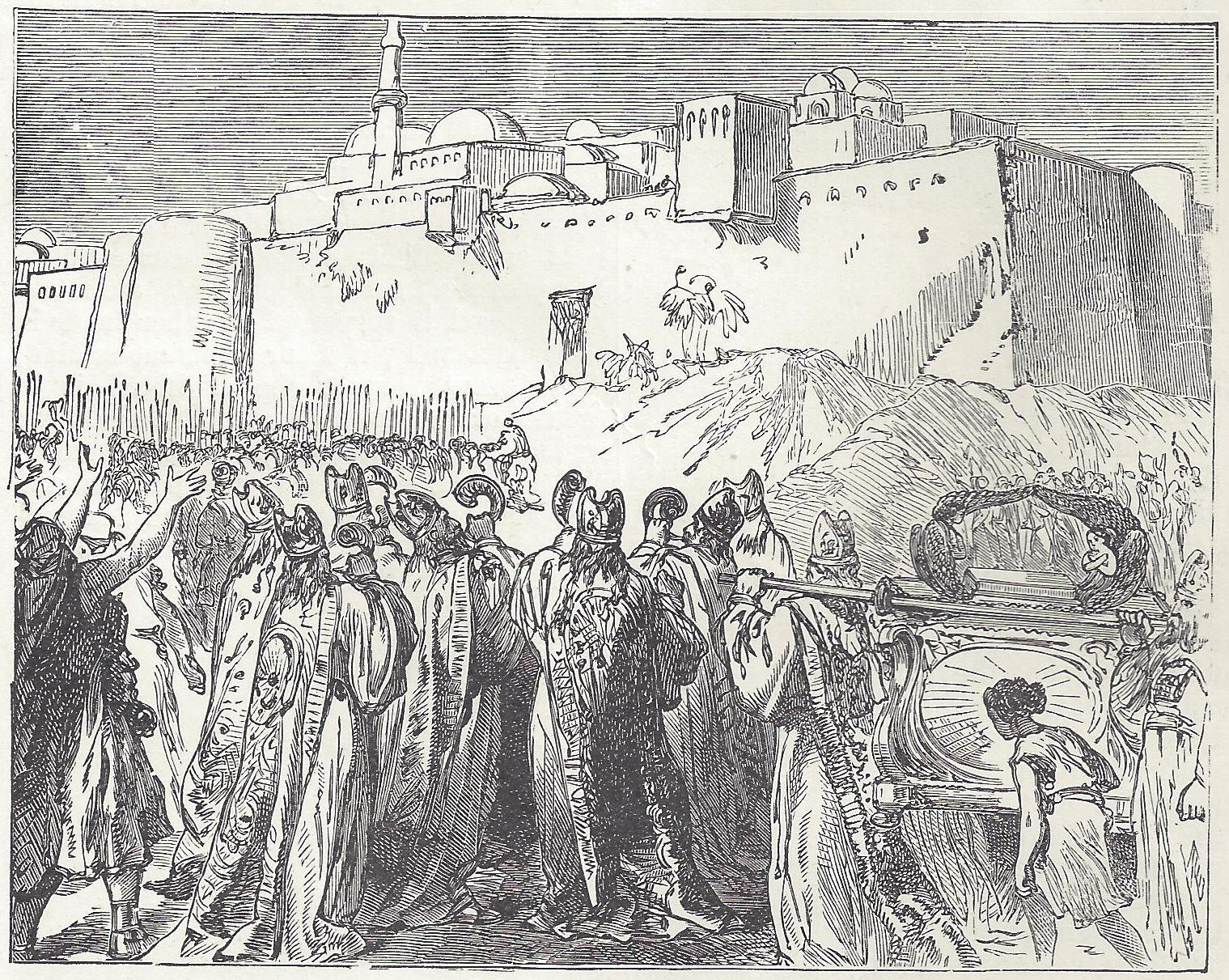 According to the Old Testament, the first task of the ancient Hebrews, led by Joshua (the successor of Moses) in entering Canaan was capturing the city of Jericho. According to historians and archaeologists, Jericho is famous as the world's oldest occupied city, having first been settled approximately 9,000 years ago. With the help of "Rahab the harlot," the Israelites learned about the inner workings of the city. Miraculously, God caused the city's walls to crumble, then come tumbling down, making it easy for the Israelites to enter. The only family spared from the Hebrews' swords was that of Rahab.
Extension activity: Students can do online research into the archæological excavations done at Jericho. |
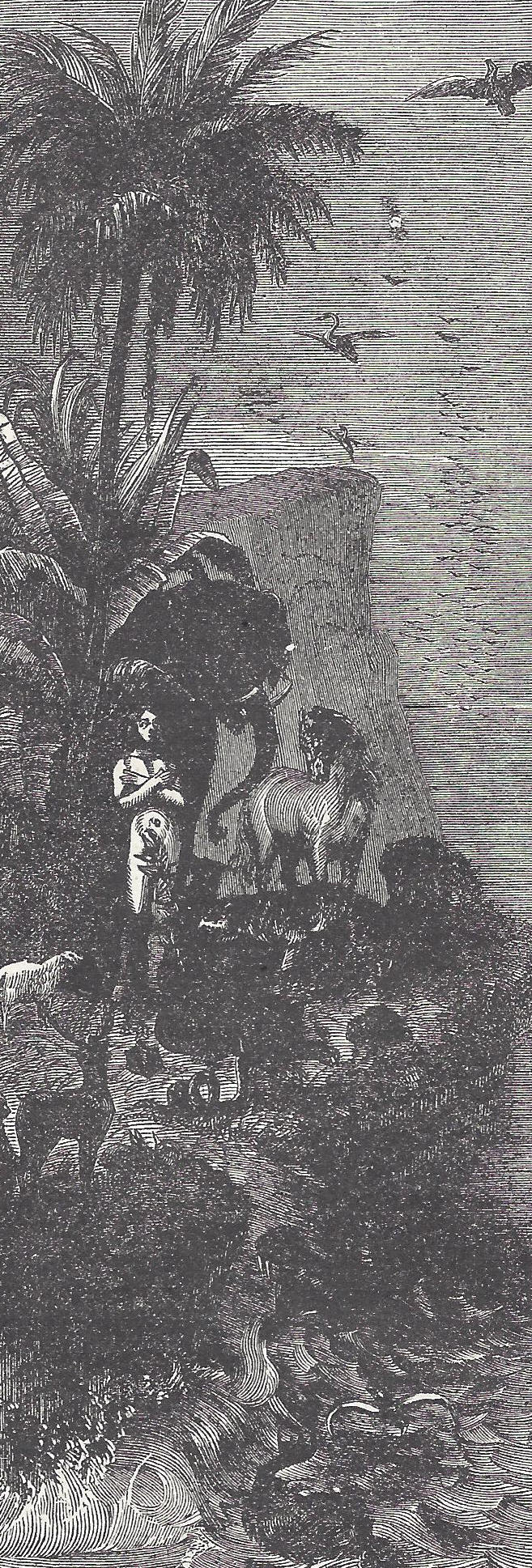 In this image, Adam is shown in the Garden of Eden. According to Abrahamic religious tradition, Adam was the first human being created by God. When Adam grew lonely, God created a mate for him, named Eve, from Adam's own rib.
Question for students: Compare and contrast the biblical origin story with the origin story of another contemporaneous culture, like that of the ancient Egyptians or Sumerians. |
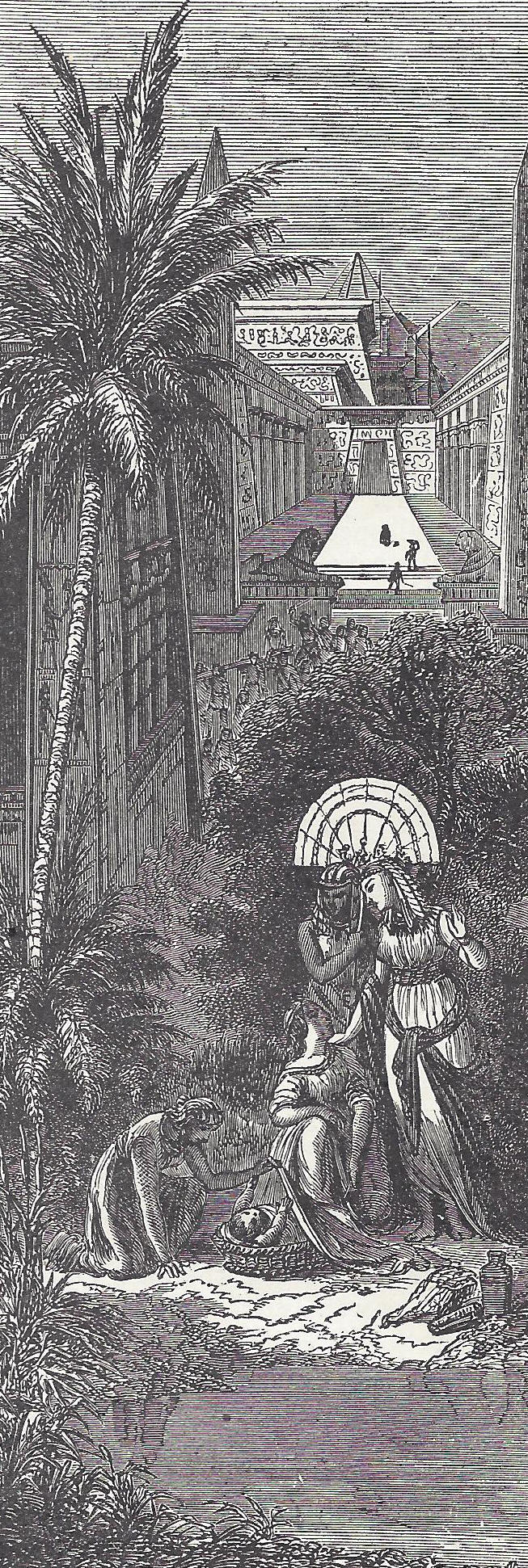 According to the Old Testament, the Egyptian pharaoh sent out a decree ordering the deaths of any Hebrew infants born. Baby Moses was placed in a basket amidst the marshes of the Nile River, where he was found by the pharaoh's daughter.
It was thus that he was raised in the Egyptian fashion at the pharaoh's court. The story of Moses' rescue from the Nile River is similar to a story that was told in ancient times of King Sargon of Akkad, founder of the Akkadian dynasty in Mesopotamia during the 23rd century B.C.E. |
 |  |  |  |  |  |
| www.studenthandouts.com ↣ World History ↣ Ancient Near East Educational Materials ↣ Ancient Near East Maps & Pictures |