
| Chinese Communist Revolution Writing Exercises Worksheets |
|---|
| www.studenthandouts.com ↣ World History ↣ Chinese Revolutions ↣ Chinese Revolutions Worksheets |
 |
    |
|
Click here to print (PDF file). Students' answers will vary.
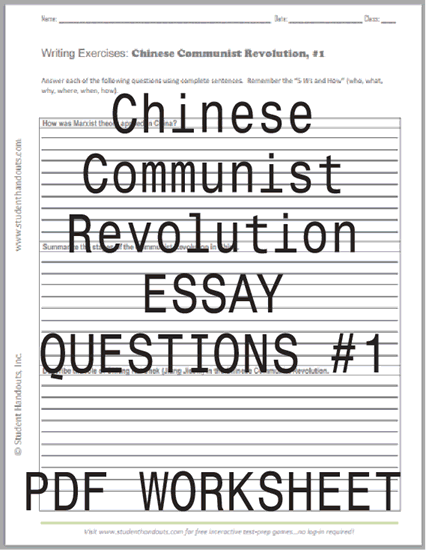
Answer each of the following questions using complete sentences. 1. How was Marxist theory applied in China? Marxist theory in China was adapted to fit the country's largely agrarian society. Mao Zedong emphasized the role of the peasantry, rather than the urban proletariat, as the revolutionary force. Land redistribution, collectivization, and class struggle were key elements, while Maoism promoted continuous revolution to prevent the rise of capitalist tendencies within socialism. 2. Summarize the stages of the Communist Revolution in China. The Communist Revolution in China began with the struggle between the Nationalists (KMT) and Communists (CPC) during the Chinese Civil War (1927-1949). After Japan's defeat in WWII, the conflict resumed, culminating in the Communist victory in 1949. Mao Zedong established the People's Republic of China, followed by land reforms, collectivization, and social restructuring. 3. Describe the role of Chiang Kai-shek (Jiang Jieshi) in the Chinese Communist Revolution. Chiang Kai-shek, leader of the Nationalist Kuomintang (KMT), played a key role in the Chinese Communist Revolution by leading the Nationalist forces against the Communists during the Chinese Civil War. His government was weakened by corruption and poor public support, ultimately leading to the Communist victory in 1949, after which Chiang fled to Taiwan. |
 |
    |
|
Click here to print. Students' answers will vary.
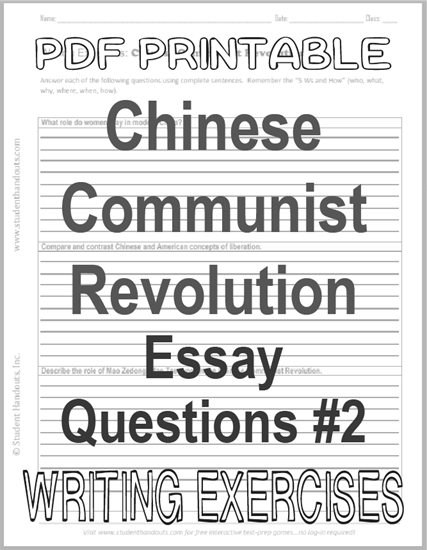
Answer each of the following questions using complete sentences. 1. What role do women play in modern China? Women in modern China play significant roles in various sectors, including politics, business, education, and the workforce. While gender equality has improved since the Communist Revolution, with increased educational and professional opportunities, traditional gender roles and challenges like the gender pay gap and underrepresentation in leadership positions still persist in society. 2. Compare and contrast Chinese and American concepts of liberation. Chinese liberation, particularly through the Communist Revolution, emphasizes collective equality, land redistribution, and class struggle, focusing on economic and social justice for peasants and workers. In contrast, American concepts of liberation prioritize individual freedoms, democratic governance, and capitalist ideals, emphasizing personal rights and liberties, including freedom of speech, religion, and economic opportunity. 3. Describe the role of Mao Zedong (Mao Tse-tung) in the Chinese Communist Revolution. Mao Zedong was the leader of the Communist Party of China and the driving force behind the Chinese Communist Revolution. He mobilized the peasantry, led the Red Army during the Chinese Civil War, and formulated Maoist ideology. Mao's leadership culminated in the 1949 Communist victory, establishing the People's Republic of China and reshaping its political and social structure. |
 |
    |
|
Click here to print. Students' answers will vary.
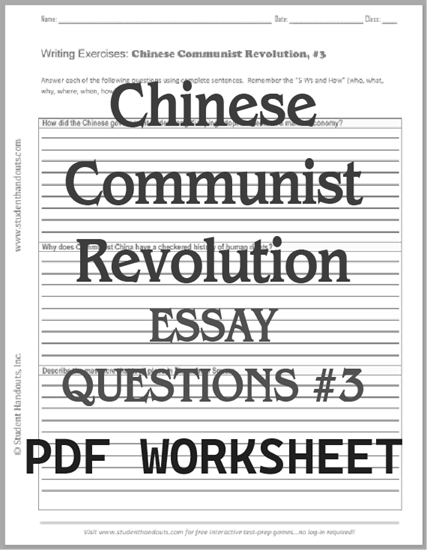
1. How did the Chinese government under Deng Xiaoping adopt elements of a market economy? Under Deng Xiaoping, the Chinese government adopted elements of a market economy through economic reforms like the "Open Door Policy," decentralizing control over industries, allowing private businesses, and encouraging foreign investment. Deng introduced Special Economic Zones (SEZs) and shifted towards a mixed economy, balancing socialism with capitalist practices to stimulate growth. 2. Why does Communist China have a checkered history of human rights? Communist China has a checkered history of human rights due to its authoritarian governance, which prioritizes state control and stability over individual freedoms. Policies such as censorship, repression of political dissent, and events like the Tiananmen Square crackdown highlight the government's suppression of civil liberties, despite efforts to improve living standards and economic rights. 3. Describe the massacre that took place in Tiananmen Square. The Tiananmen Square Massacre occurred on June 4, 1989, when Chinese military forces violently suppressed pro-democracy protests in Beijing. Demonstrators, mainly students, called for political reforms and greater freedoms. The government declared martial law, and troops opened fire, killing hundreds, possibly thousands, of civilians, marking a severe crackdown on dissent. |
| www.studenthandouts.com ↣ World History ↣ Chinese Revolutions ↣ Chinese Revolutions Worksheets |