Click here to print. Answers will vary.
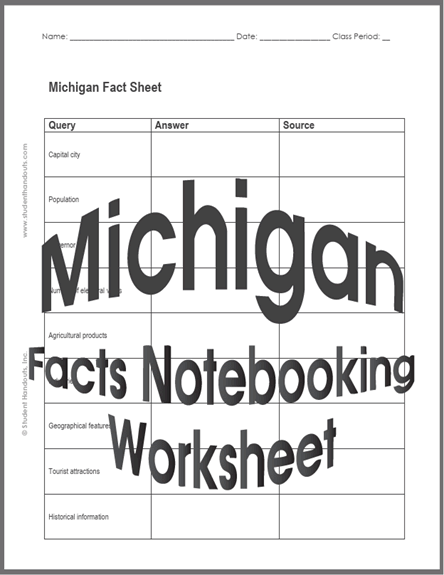
Michigan is a state in the Great Lakes region of the United States. It is unique because it consists of two main land areas, the Upper Peninsula and the Lower Peninsula, which are separated by the Straits of Mackinac. The state borders four of the five Great Lakes: Superior, Michigan, Huron, and Erie. Its topography includes rolling hills, forests, farmland, sandy beaches, rivers, and thousands of inland lakes. The Upper Peninsula has rugged terrain and mineral deposits, while much of the Lower Peninsula contains fertile plains suitable for farming.
Michigan’s industries have developed partly because of its location and natural resources. Agriculture is important, with farmers growing corn, soybeans, apples, cherries, and other crops. The state is especially known for its automobile industry. Detroit became a major center of car manufacturing during the early twentieth century, helping transform transportation around the world. Michigan also supports tourism, fishing, forestry, mining, and shipping. The Great Lakes provide important routes for moving goods and connecting communities.
Michigan has a rich and varied history. Indigenous peoples, including the Anishinaabe nations, lived in the region long before European settlement. French explorers and traders arrived during the seventeenth century, followed by British control and later American settlement. Michigan became the twenty-sixth state in 1837. During the nineteenth century, logging, mining, and farming helped its economy grow. In the twentieth century, automobile manufacturing attracted workers from across the United States and other countries. Detroit became an important center of industrial growth and cultural change.
Today, Michigan combines natural beauty, important industries, and a diverse cultural heritage. Its geography and history continue to shape the lives of its residents.
|