Click here to print. Students' answers will vary.
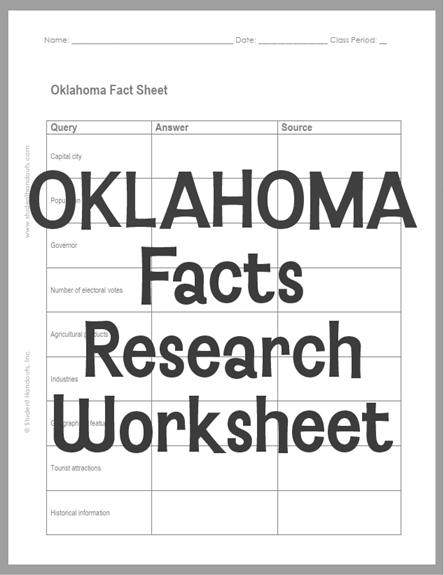
For students in grades five and up. Pupils research the state and cite their sources.
Oklahoma's land is mostly rolling plains that slope down from northwest to southeast. The highest point is Black Mesa in the Panhandle, and the lowest is in the southeast corner. Eastern Oklahoma has more rugged areas, including the Ozark Plateau and Ouachita Mountains. The state sits in "Tornado Alley," so severe storms are common.
 Oklahoma's economy relies heavily on energy and agriculture. The state ranks fifth in the nation for crude oil production and sixth for natural gas . Wind power is also growing fast, ranking third nationally. Farming uses more than 75 percent of the land, with wheat, cotton, and cattle being important.
Historically, Oklahoma was home to many Native American tribes. In the 1830s, the U.S. government forced tribes from the East to move here on the "Trail of Tears." In 1889, the government opened land to white settlers, who rushed in to claim plots—earning the nickname "Sooners."
Oklahoma became the 46th state in 1907.
|