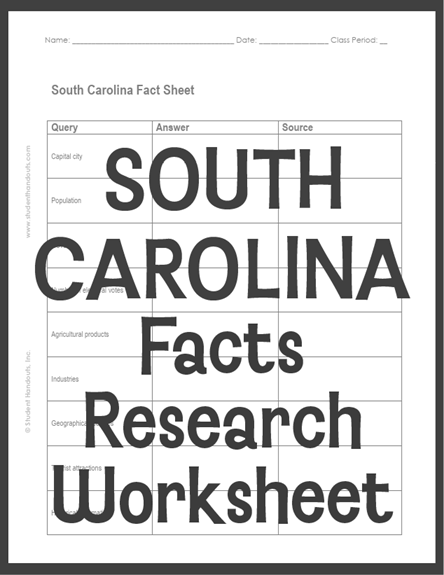
This is designed for students in grades five and up, and tasks pupils with research the state and citing their sources.
Click here to print. Students' answers will vary.
South Carolina's land changes a lot from west to east. The Blue Ridge mountains in the northwest include Sassafras Mountain, the state's highest point at 3,560 feet. Next comes the Piedmont, with rolling hills and rocky monadnocks like Table Rock. The Sandhills form an old coastline, and the Coastal Plain stretches flat to the Atlantic, covering about two-thirds of the state.
 Farming has always mattered here. Colonists grew rice and indigo, and cotton later became huge, though the boll weevil hurt crops in the 1920s. Today, broilers (chickens) are the most valuable farm product, and the state also grows cotton, peanuts, and peaches. Textile factories grew in the early 1900s, and today manufacturing and tourism are big industries too.
Historically, South Carolina was one of the original 13 colonies, settled by the English in 1670 near Charleston. It had more Revolutionary War battles than any other state. It was also the first state to leave the Union in 1860, and the Civil War's first shots were fired at Fort Sumter.
|