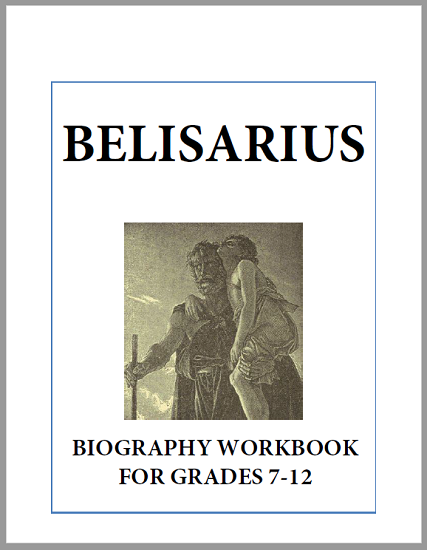
Belisarius (505-565 C.E.) - Learn all about this famous and powerful Roman general, who sought, under Emperor Justinian of the Eastern Roman (Byzantine) Empire, to reconquer the city of Rome.
This item, eleven pages in length and full of questions and activities, is part of our Biography Workbooks series. It is designed for junior and senior high school students.
Click here to print. The answer key is below.
Few men have performed greater achievements than this general, to whom it was given to be conqueror again and again over nations hitherto invincible, and to arrest, during his own lifetime, the disintegration of the Roman Empire. He lived in the early part of the sixth century of the Christian era, though the date of his birth is not certainly known, and he was in the prime of life about 530. Belisarius is believed to have been the son of a peasant of Thrace, probably of Slavonian descent, as his name, stripped of its classical form, would belong to that language and would be Beli-than, or the White Prince.
Apparently he began life as a common soldier, and gradually rose by courage and ability. His master, the Emperor Justinian, was an equally remarkable personage, capable of conceiving and accomplishing magnificent designs, yet withal of a mean, ungenerous, ungrateful character. Justinian was responsible for the codification (under Christianized conditions) of the old Roman law (known as the Justinian Code), so as to serve as the foundation of jurisprudence to all the European nations except the English; the building of the church of St. Sophia (Hagia Sophia); and the rolling back for a time the flood that on all sides was overwhelming the ancient Empire of Rome, were all due to this prince.
Answer Key: 1. Peasant of Thrace, possibly of Slavonian descent; 2. Justinian; 3. Odoacer; 4. Constantinople; 5. Answers will vary; 6. Arians; 7. Antonina; 8. Theodora; 9. Heraclea; 10. K - personage; 11. G - heretic; 12. B - codification; 13. L - vigorous; 14. F - entreated; 15. H - insubordination; 16. I - invincible; 17. D - disintegration; 18. J - jurisprudence; 19. A - coalesce; 20. E - endeavor; 21. C - devastate; 22. Gelimer; 23. Galatia; 24. Stifled in the bath by her husband, Theodatus; 25. He held their wives and children as hostages; 26. They enlarged an aqueduct and sneaked in; 27. Theodatus; 28. Wittich; 29. Justinian feared the success of Belisarius; 30. C - Totila; 31. Answers will vary.
|