

| Byzantine Empire Writing Exercises Worksheets |
|---|
| www.studenthandouts.com ↣ World History ↣ Byzantine Empire Educational Resources ↣ Byzantine Empire Worksheets |
 |
    |
|
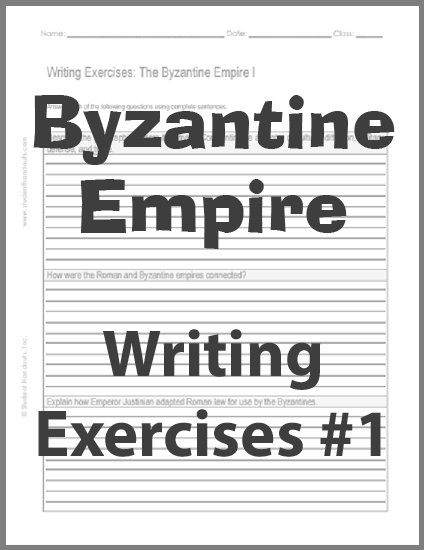
Byzantine Empire Writing Exercises Sheet #1: Answer each of the following questions using complete sentences.
1. Describe the geographic factors that made Constantinople a center of cultural diffusion, military defense, and trade. Constantinople's location on the Bosporus Strait, between Europe and Asia, made it a prime center for trade, cultural exchange, and military defense. It connected key land and sea routes, allowing goods and ideas to flow between continents. Surrounded by water on three sides and fortified by strong walls, the city was easily defended, making it a powerful and influential hub for centuries. 2. How were the Roman and Byzantine empires connected? The Byzantine Empire was the eastern continuation of the Roman Empire after its western half fell in 476 C.E. Centered in Constantinople, it preserved Roman law, government structures, and culture, while gradually adopting Greek language and Orthodox Christianity. Emperors like Justinian sought to restore Roman glory, linking the two empires through shared heritage and enduring influence. 3. Explain how Emperor Justinian adapted Roman law for use by the Byzantines. Emperor Justinian adapted Roman law for the Byzantine Empire by ordering the compilation and organization of centuries of Roman legal texts into a unified system known as the Corpus Juris Civilis, or Body of Civil Law. This legal code clarified and preserved Roman principles, making them more accessible and applicable for Byzantine use. It influenced later European legal systems. Click here to print this sheet of writing exercises (PDF). Students' answers will vary. Constantinople's strategic location on the Bosporus Strait made it a vital hub for cultural diffusion, military defense, and trade. It connected Europe and Asia, facilitating the exchange of goods, ideas, and cultures. The city's natural harbor, the Golden Horn, provided protection and access for trade ships. Its defensible position, with water on three sides and formidable walls, made it a military stronghold, safeguarding the city for centuries. The Byzantine Empire was the direct continuation of the Roman Empire, with its capital established at Constantinople by Emperor Constantine in 330 C.E. While the Western Roman Empire fell in 476 C.E., the Eastern Roman Empire, known as the Byzantine Empire, preserved Roman legal, cultural, and architectural traditions. The Byzantines spoke Greek and adopted Orthodox Christianity, serving as a bridge between the ancient Roman world and medieval Europe. Emperor Justinian adapted Roman law for the Byzantine Empire by commissioning the Corpus Juris Civilis, or Body of Civil Law, completed in 529-534 C.E. This comprehensive codification streamlined and updated centuries of Roman legal texts, eliminating contradictions and obsolete laws. It consisted of the Code, Digest, Institutes, and Novels, serving as the foundation of Byzantine legal practice and influencing European legal systems for centuries. |
 |
   |
|
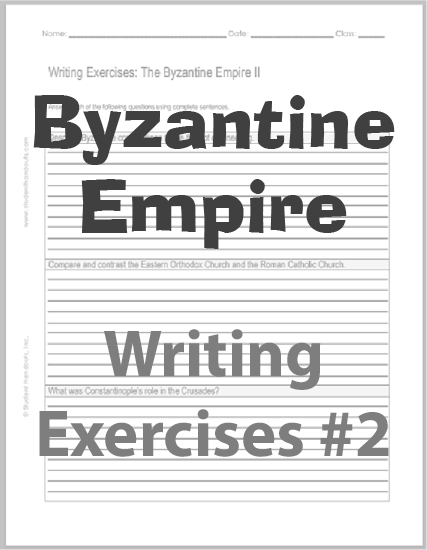
Byzantine Empire Writing Exercises Handout #2: Answer each of the following questions using complete sentences.
1. Describe Byzantine contributions to the field of engineering. The Byzantines made significant contributions to engineering, particularly in architecture and military technology. They mastered the use of domes, exemplified by the Hagia Sophia, which featured an innovative dome supported by pendentives. They also developed advanced fortifications and aqueduct systems. One notable invention was Greek fire, a powerful incendiary weapon used in naval warfare, showcasing their technical ingenuity. 2. Compare and contrast the Eastern Orthodox Church and the Roman Catholic Church. The Eastern Orthodox and Roman Catholic Churches share Christian roots and core beliefs but differ in leadership, language, and practices. The Roman Catholic Church recognizes the Pope as supreme authority and uses Latin in services (almost exclusively, in fact, before major reforms in the 1960s), while the Eastern Orthodox Church rejects papal supremacy and uses local languages. Orthodox priests may marry, and their rituals and traditions reflect Byzantine influence, whereas Catholic practices follow Western European customs. 3. What was Constantinople’s role in the Crusades? Constantinople played a strategic and political role in the Crusades as a gateway between Europe and the Holy Land. Crusaders often passed through the city, relying on its resources and guidance. Byzantine emperors negotiated with Crusaders for support against Muslim forces. However, tensions grew, and in 1204, during the Fourth Crusade, Crusaders infamously sacked Constantinople, weakening the Byzantine Empire. Click here to print this handout of writing exercises on the Byzantine empire (PDF). Students' answers will vary. The Byzantines made significant contributions to engineering, particularly in architecture and military technology. They perfected the use of the pendentive dome, exemplified by the Hagia Sophia, which combined vast interior spaces with structural stability. Byzantine engineers also developed advanced fortifications, including massive walls like those of Constantinople, which featured multiple layers and defensive towers. Innovations in hydraulic engineering, such as aqueducts and sophisticated water systems, further showcased their technical expertise. The Eastern Orthodox and Roman Catholic Churches share foundational Christian beliefs but differ in practices and theology. The Orthodox Church rejects the Pope's authority, emphasizing conciliar leadership, while the Catholic Church recognizes the Pope as the supreme spiritual leader. The Orthodox Church uses the Julian calendar and conducts liturgy in Greek or local languages, whereas the Catholic Church traditionally uses the Gregorian calendar and Latin (though local languages are now common). These differences led to the 1054 Great Schism. Constantinople played a critical role in the Crusades as a strategic gateway between Europe and the Holy Land. It served as a staging ground and supply base for Crusader armies. The Byzantine Empire's emperors often negotiated with Crusaders for military assistance or passage. Tensions culminated in the Fourth Crusade (1202-1204), when Crusaders disastrously sacked Constantinople, weakening Byzantine power and leading to its eventual fall to the Ottomans in 1453. |
 |
   |
|
Essay Questions Sheet #3: Answer each of the following questions using complete sentences. 1. What caused the schism (split) between the Eastern (Orthodox or Greek) and Western (Catholic or Roman) branches of Christianity in 1054? The schism of 1054 between the Eastern Orthodox and Western Catholic churches was caused by growing political, cultural, and theological differences. Key issues included disputes over papal authority, the use of Latin versus Greek in services, and the Filioque clause added to the Nicene Creed by the West. These tensions culminated in mutual excommunications, formally dividing the two branches. 2. Explain how the fall of Constantinople to the Turks in 1453 was a turning point in world history. The fall of Constantinople to the Ottoman Turks in 1453 marked the end of the Byzantine Empire and a major shift in world history. It gave the Ottomans control of a vital trade route between Europe and Asia, prompting Europeans to seek new sea routes. This event also symbolized the rise of Islamic power and influenced the start of the Age of Exploration. 3. How did the Byzantine empire help to preserve and transmit classical Greek and Roman culture and knowledge? The Byzantine Empire preserved and transmitted classical Greek and Roman culture by maintaining libraries, copying ancient manuscripts, and teaching classical literature, philosophy, and science. Byzantine scholars studied works by Plato, Aristotle, and others, ensuring their survival. After the fall of Constantinople in 1453, many scholars fled to Western Europe, bringing ancient knowledge that helped spark the Renaissance and revive classical learning. Click here to print this sheet of essay questions on the Byzantine empire (PDF). Pupils' answers will vary. The schism between the Eastern Orthodox and Western Catholic branches of Christianity in 1054 was caused by theological, political, and cultural differences. Key issues included disputes over papal authority, the wording of the Nicene Creed (specifically the "Filioque" clause), and various liturgical practices. The mutual excommunication of the Pope and the Patriarch of Constantinople, exacerbated by longstanding tensions, formalized the split, leading to a permanent division between the two branches. The fall of Constantinople to the Turks in 1453 marked the end of the Byzantine Empire and shifted the balance of power to the Ottoman Empire, which expanded into Europe, Asia, and Africa. It spurred the Renaissance by prompting Greek scholars to flee westward, bringing classical knowledge to Europe. The fall also disrupted trade routes to the East, encouraging European exploration and the eventual discovery of new trade routes, including the Americas. The Byzantine Empire preserved and transmitted classical Greek and Roman culture by maintaining libraries, copying ancient texts, and fostering centers of learning, such as the University of Constantinople. Byzantine scholars studied and commented on classical works, integrating them into Byzantine education. During the Renaissance, fleeing Byzantine scholars brought these texts to Western Europe, reintroducing classical knowledge and stimulating intellectual revival. The empire's preservation efforts were crucial for the survival of classical heritage. |
| Byzantine Empire Books and Films | Byzantine Empire Outlines and PowerPoints |
| Byzantine Empire Maps and Pictures | Byzantine Empire Educational Games |
| Byzantine Empire Miscellany | Byzantine Empire Worksheets |
| www.studenthandouts.com ↣ World History ↣ Byzantine Empire Educational Resources ↣ Byzantine Empire Worksheets |