
| The Punic Wars (264-146 B.C.E.) PDF Outline |
|---|
| www.studenthandouts.com > World History > Ancient Rome > Outlines and PowerPoints |
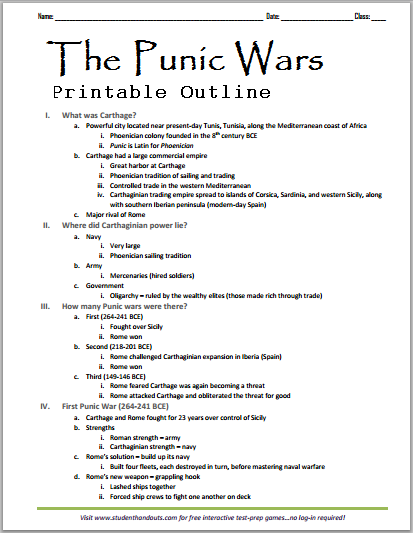 I. What was Carthage?
a. Powerful city located near present-day Tunis, Tunisia, along the Mediterranean coast of Africa i. Phoenician colony founded in the 8th century B.C.E. ii. Punic is Latin for Phoenician b. Carthage had a large commercial empire i. Great harbor at Carthage ii. Phoenician tradition of sailing and trading iii. Controlled trade in the western Mediterranean iv. Carthaginian trading empire spread to islands of Corsica, Sardinia, and western Sicily, along with southern Iberian peninsula (modern-day Spain) c. Major rival of Rome II. Where did Carthaginian power lie? a. Navy i. Very large ii. Phoenician sailing tradition b. Army i. Mercenaries (hired soldiers) c. Government i. Oligarchy—ruled by the wealthy elites (those made rich through trade) III. How many Punic wars were there? a. First (264-241 B.C.E.) i. Fought over Sicily ii. Rome won b. Second (218-201 B.C.E.) i. Rome challenged Carthaginian expansion in Iberia (Spain) ii. Rome won c. Third (149-146 B.C.E.) i. Rome feared Carthage was again becoming a threat ii. Rome attacked Carthage and obliterated the threat for good IV. First Punic War (264-241 B.C.E.) a. Carthage and Rome fought for 23 years over control of Sicily b. Strengths i. Roman strength—army ii. Carthaginian strength—navy c. Rome's solution—build up its navy i. Built four fleets, each destroyed in turn, before mastering naval warfare d. Rome's new weapon—grappling hook i. Lashed ships together ii. Forced ship crews to fight one another on deck 1. Hand-to-hand fighting was a Roman strength e. Rome won—Sicily became a province of Rome V. In the meantime... a. Rome i. Rome came to control Corsica and Sardinia ii. Rome conquered the Gauls of the Po River Valley b. Carthage i. Carthage recovered from its defeat by Rome ii. Carthage started expanding in Iberia (Spain) VI. Second Punic War (218-201 B.C.E.) a. Carthage: General Hannibal i. Led 60,000 men and dozens of elephants through Spain, along the Mediterranean cost, through Gaul, and across the Alps to Italy ii. Fought in Italy for 15 years, winning many battles 1. Battle of Cannae (216 B.C.E.) a. Romans lost over 50,000 soldiers 2. But Hannibal could not capture the city of Rome b. Rome: General Scipio i. Led an army against Carthaginian Iberia (modern-day Spain) ii. Then led an army against Carthage itself iii. Then returned to Italy to defend the city of Rome iv. Battle of Zama (202 B.C.E.) 1. Hannibal's first and only defeat a. Hannibal escaped and returned to Carthage v. Carthage lost its fleet, Iberia, and the larger part of its territory in northern Africa c. Battle of the Metaurus (207 B.C.E.) i. Pivotal battle of the Second Punic War ii. Hannibal's brother, Hasdrubal, was bringing supplies and equipment to his brother for the siege against Rome iii. Consul Marcus Livius was reinforced when Consul Gaius Claudius Nero brought troops via a forced march iv. Carthaginians were outnumbered and Hasdrubal was defeated v. Consul Gaius Claudius Nero severed the head of Hasdrubal and had it thrown into Hannibal's camp as a threat VII. In the meantime... a. Carthage i. Carthage rebuilt its trading networks and commercial power b. Rome i. Rome felt threatened by competition from Carthage ii. Senator Cato ended all of his speeches with the warning: "Carthago delenda est!" ("Carthage must be destroyed!") VIII. Third Punic War (149-146 B.C.E.) a. Rome made ridiculous demands of Carthage i. 300 noble children to be given to Rome as hostages ii. Carthage to be destroyed and rebuilt away from the coast b. Carthage refused i. Carthage had no mercenaries ii. Forced to defend their own city c. Romans laid siege to Carthage i. Roman siege was successful ii. Romans burnt Carthage to the ground—became a Roman province iii. Men killed; women and children sold into slavery IX. Results of the Punic Wars—during and after a. Rome and Carthage had been what you might call the "superpowers" of the Mediterranean at the time i. Rome's defeat of Carthage left Rome as the only remaining "superpower" ii. It was much easier for Rome to conquer the rest of the Mediterranean once Carthage was out of the way b. Roman control of Macedonia i. Hannibal had made an alliance with the Macedonian king ii. Rome attacked and defeated Macedonia in 197 B.C.E. c. Rome went on to conquer the remnants of Alexander the Great's empire in Eurasia i. Fighting among the Greek city-states 1. Rome took over, ending Greek independence (146 B.C.E.) ii. Kingdom of Pergamum 1. In modern-day Turkey 2. Under Roman rule in 133 B.C.E. X. Provincial governments a. Each conquered area was a province of Rome b. Proconsuls i. Each province was governed by a Roman proconsul ii. Typically a member of the patrician (noble) class iii. More often than not these were corrupt c. Publicans i. Publicans were tax collectors ii. Became a publican by auctioning for the job iii. Squeezed as much money out of conquered peoples as they could XI. Rome grows wealthy a. Money (from taxes and war booty) and cheap goods flooded Rome i. Africa and Sicily—wheat ii. Spain—silver and tine iii. East—gems and luxury goods iv. Upper classes grew wealthier, and new class of wealthy merchants and traders emerged b. Government had more money than ever before i. Whoever controlled the government could use this money for its own needs (e.g., government contracts) ii. This caused tension in the struggle for control of the government XII. Old Roman values diminish a. Roman army i. Originally, it was staffed by volunteers ii. Professional army lacked the former volunteer fighting spirit b. Morals and values i. Corruption replaced dedication to public service ii. Pursuit of luxury, pleasure, and soft living replaced hard work, patriotism, and simplicity XIII. What did expansion mean for Rome? a. Pros i. Wealth 1. From trade 2. From taxes ii. Power 1. Control of most of the Mediterranean b. Cons i. Difficult to manage an empire 1. Multicultural empire required a multifaceted approach ii. Wealth created new classes in Rome 1. Slaves gained by conquests displaced free farmers and workers 2. These problems ultimately ended the "Republic" and led to the "Empire" XIV. Rich get richer, poor get poorer a. Money from government contracts (building bridges, roads, and ships; supplying the armies) b. High-interest loans c. Bribes and graft in the provinces d. Latifundia, the large farms of the wealthy, became operated by slaves e. Poor farmers and workers could not compete with the products of slave labor f. Wealthy class bought up the lands of impoverished farmers g. Impoverished farmers and others flooded the city of Rome h. These unemployed masses had one thing left—their right to vote i. These unemployed masses—the "Roman mob"—threw their support to those politicians who offered "bread and circuses" XV. Review questions a. Where was the city of Carthage located? b. What was the basic, underlying cause of all of the Punic wars? c. Describe the military actions of Hannibal. d. Why was it easier for Rome to expand following the defeat of Carthage? e. How did Rome grow wealthy as its territory expanded? f. How was the "Roman mob" created? Click here to print. Click here for this outline in PowerPoint format. |
 |  |  |  |  |  |
|---|
| Ancient Rome Books and Films | Ancient Rome Outlines and PowerPoints |
| Ancient Rome Maps and Pictures | Ancient Rome Study Games |
| Ancient Rome Miscellany | Ancient Rome Worksheets |
| www.studenthandouts.com > World History > Ancient Rome > Outlines and PowerPoints |