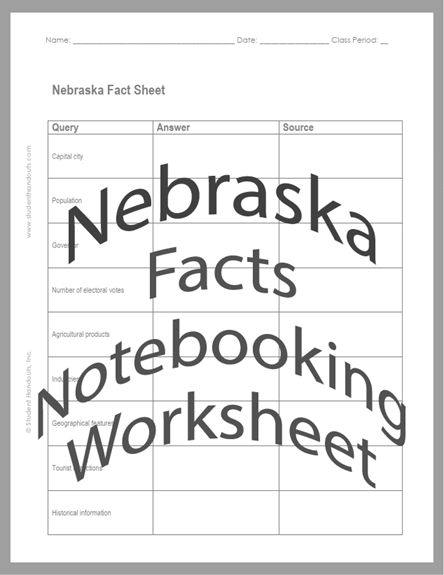
Click here to print. Students' answers will vary. Students must cite their sources!
Nebraska is a state in the Great Plains region of the United States. Its landscape includes wide prairies, rolling hills, fertile plains, and the unusual Sandhills, a large area of grass-covered sand dunes in the north-central part of the state. The Platte River crosses Nebraska and has long provided water for people, farms, and wildlife. The state experiences hot summers, cold winters, and changing rainfall, which influence agriculture and everyday life.
Agriculture is one of Nebraska's most important industries. Farmers grow corn, soybeans, wheat, and other crops, while cattle ranching supports the livestock industry. The state is a major producer of beef and corn. Nebraska also has food processing, manufacturing, transportation, and energy industries. Its central location makes it an important connection point for highways and railroads that carry goods across the country. Wind energy has also become an important part of the state's energy production.
Nebraska's history includes many different peoples and important changes. Indigenous nations, including the Omaha, Ponca, and Pawnee, lived in the region long before European settlement. During the nineteenth century, explorers, traders, and settlers traveled through Nebraska on routes leading west. The Oregon, California, and Mormon Trails crossed the state, bringing thousands of travelers through the region. Nebraska became a U.S. territory in 1854 and joined the Union as the thirty-seventh state on March 1, 1867. Farming and railroad construction helped communities grow during the late nineteenth century.
Today, Nebraska combines productive farmland, important transportation routes, and a rich cultural heritage. Its landforms and natural resources continue to influence its economy and communities. Studying Nebraska's topography, industries, and history helps students understand how geography shapes settlement, economic growth, and daily life.
|