

| South Dakota Research Worksheet |
|---|
| www.studenthandouts.com ↣ Geography ↣ North America ↣ U.S.A. ↣ U.S. Midwest ↣ South Dakota Geography |
 |
    |
|
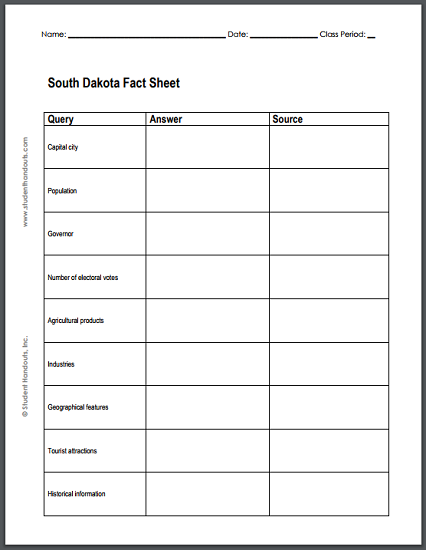
Students are asked to conduct research on the state of South Dakota, providing basic facts while citing their sources. This activity can be completed independently or in pairs or groups.
Click here to print. Students' answers will vary. South Dakota is a state in the Great Plains region of the United States. Its landscape includes wide prairies, rolling hills, river valleys, and rugged mountains. The Missouri River divides much of the state into eastern and western regions. Eastern South Dakota has fertile soils and relatively flat land that supports farming. Western South Dakota includes the Black Hills, a forested mountain region known for its unusual rock formations, wildlife, and scenic beauty. The Badlands feature steep cliffs, deep valleys, and colorful layers of rock shaped by erosion. Agriculture is one of South Dakota's leading industries. Farmers grow corn, soybeans, wheat, and other crops, while cattle ranching provides meat and other products. The state also produces gold and other minerals, and wind energy contributes to its electricity supply. Tourism is important, especially in the Black Hills, where visitors explore Mount Rushmore National Memorial, Custer State Park, and Badlands National Park. These attractions support hotels, restaurants, and local businesses. South Dakota has a rich history that includes Indigenous cultures, exploration, settlement, and economic change. Lakota, Dakota, and Nakota peoples have longstanding connections to the region. During the nineteenth century, European American settlers arrived in greater numbers, and the discovery of gold in the Black Hills attracted miners. This settlement led to serious conflicts and the loss of Indigenous lands. South Dakota became a state on November 2, 1889, sharing that date with North Dakota. Today, South Dakota combines important agricultural industries, natural resources, and cultural traditions. Its varied landscape influences where people live, how they earn a living, and which places attract visitors. Studying the state's topography, industries, and history helps students understand how geography and historical events shape communities over time. |
| www.studenthandouts.com ↣ Geography ↣ North America ↣ U.S.A. ↣ U.S. Midwest ↣ South Dakota Geography |