Click here to print. Students' answers will vary.
Vermont's land is shaped by the Green Mountains, which run down the middle of the state like a backbone. These mountains were formed long ago and are made mostly of hard metamorphic rock like schist and gneiss. The mountains divide the state into two main areas. To the west is the Champlain Valley, a flat area with rich soil along Lake Champlain. To the east is the Connecticut River Valley. Vermont also has many lakes and ponds, most of which were carved out by giant ice sheets during the Ice Age. The scenery is beautiful, with mountains, valleys, and clear water.
Vermont's industries today include tourism, manufacturing, and agriculture. Tourism is a big part of the economy, bringing in about $3 billion in visitor spending and supporting around 30,000 jobs. People come to ski in winter, hike in summer, and enjoy the fall leaves. Manufacturing employs about 27,500 people and makes up over 8% of the state's GDP. Farming is also important—Vermont is famous for its dairy products and maple syrup.
Vermont's history is full of interesting stories. Native American tribes, mainly the Abenaki, lived on this land for thousands of years before Europeans arrived. In the 1700s, both New Hampshire and New York claimed the land, which caused big arguments. Ethan Allen and his Green Mountain Boys formed a group to protect the settlers' land. Vermont even became its own independent republic from 1777 to 1791, with its own coins and postal service, before joining the United States as the 14th state.
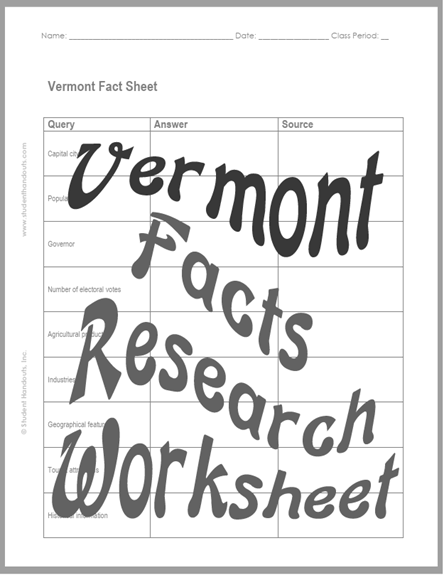
Students in grades five and up are tasked with researching the state and citing their sources.
|