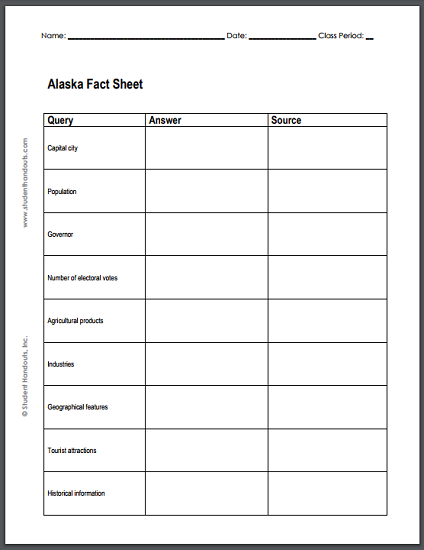
This free printable worksheet has students independently research the state of Alaska, including the citation of sources for the state's capital city, population, governor, number of electoral votes, agricultural products, industries, geographical features, tourist attractions, and history.
Click here to print. Students' answers will vary.
Alaska is the largest state in the country, and its land is full of extremes. The northern coast is flat, treeless tundra where the ground stays frozen all year. South of that are the Brooks Range mountains. The middle of the state is a huge plain with forests, marshes, and lakes, and the Yukon River flows through it. Along the southern coast, the Alaska Range and Aleutian Range curve along the ocean. Denali, in the Alaska Range, is the highest mountain in North America at over 20,000 feet.
Alaska's economy is driven by natural resources. Oil and gas are the biggest part, and oil money supplies a large share of the state budget. Fishing is also huge—Alaska is the number one producer of wild salmon in the world. Tourism brings over a million visitors each year, and timber and mining are important too.
Historically, the United States bought Alaska from Russia in 1867 for $7.2 million. Many people laughed at the deal and called it "Seward's Folly." Then gold was discovered, and later oil was found at Prudhoe Bay in 1968. The Trans-Alaska Pipeline was finished in 1977 to move oil across the state. Alaska became the 49th state in 1959.
|