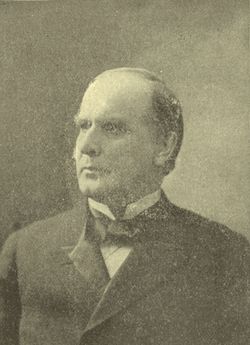
 President William McKinley, the 25th president of the United States, led the nation during a pivotal era of emergence as a global power. Serving from 1897 until his assassination in 1901, McKinley's presidency was defined by economic prosperity and territorial expansion. A former Ohio congressman and Civil War veteran, he championed protective tariffs, notably the Dingley Tariff of 1897, to shield American manufacturing and restore growth following the Panic of 1893.
 McKinley's legacy, however, is most tied to the Spanish-American War of 1898. Initially reluctant to intervene in Cuba's rebellion against Spain, he sought diplomacy but ultimately requested a declaration of war after the explosion of the U.S.S. Maine. The swift American victory stripped Spain of Cuba, Puerto Rico, Guam, and the Philippines, marking the U.S. as an imperial power. McKinley defended annexation as a duty to "civilize and Christianize," though it sparked fierce domestic anti-imperialist opposition.
His second term began with promise, but in September 1901, an anarchist shot him at the Pan-American Exposition in Buffalo. He died eight days later, elevating Vice President Theodore Roosevelt. While McKinley is often overshadowed by Roosevelt, his leadership established the template for modern, assertive American foreign policy. His face graced the $500 bill, and North America's highest point—Mount McKinley (now Denali)—was named in his honor until 2015 (though Trump federally designated it Mount McKinley in 2025). McKinley's balanced handling of industry and overseas expansion set the stage for the American century.
|








































 McKinley's legacy, however, is most tied to the Spanish-American War of 1898. Initially reluctant to intervene in Cuba's rebellion against Spain, he sought diplomacy but ultimately requested a declaration of war after the explosion of the U.S.S. Maine. The swift American victory stripped Spain of Cuba, Puerto Rico, Guam, and the Philippines, marking the U.S. as an imperial power. McKinley defended annexation as a duty to "civilize and Christianize," though it sparked fierce domestic anti-imperialist opposition.