

| Wisconsin Notebooking Worksheet |
|---|
| www.studenthandouts.com ↣ Geography ↣ North America ↣ U.S.A. ↣ Midwest ↣ Wisconsin Geography |
 |
    |
|
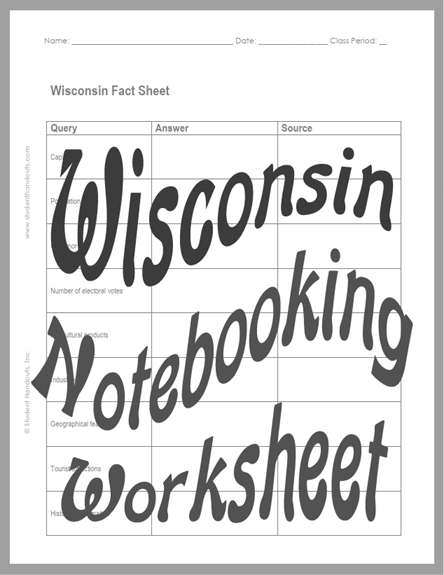
Click here to print. Students' answers will vary.
Students must supply facts, along with sources for those facts. Wisconsin is a state in the Upper Midwest known for its forests, lakes, rivers, and fertile farmland. It borders Lake Superior to the north and Lake Michigan to the east. Much of the state has rolling hills and plains, while northern Wisconsin contains extensive forests and many lakes. The Wisconsin River flows through the state, providing water for communities, wildlife, and recreation. Glaciers shaped much of Wisconsin's landscape during the Ice Age, leaving behind hills, valleys, and lakes that remain important features today. Wisconsin has a diverse economy supported by agriculture, manufacturing, tourism, and natural resources. The state is famous for dairy farming and cheese production, earning it the nickname "America's Dairyland." Farmers also grow corn, soybeans, cranberries, and other crops. Manufacturing is another major industry, with businesses producing machinery, paper products, food, and transportation equipment. The Great Lakes, forests, and outdoor recreation areas attract visitors who enjoy fishing, boating, hiking, and winter sports. Cities such as Milwaukee and Madison are important centers for business, education, and technology. Wisconsin's history began long before European settlement. Indigenous peoples, including the Ho-Chunk, Menominee, Ojibwe, and Potawatomi, lived in the region and developed strong connections to its land and waterways. French explorers and fur traders arrived during the seventeenth century. Later, American settlers established farms, mining communities, and towns. Wisconsin became the thirtieth state on May 29, 1848. During the nineteenth and twentieth centuries, agriculture, logging, mining, and manufacturing helped the state grow. Today, Wisconsin combines natural beauty, productive industries, and diverse cultural traditions. Its geography has influenced where communities developed and how people earn their living. Studying Wisconsin's topography, industries, and history helps students understand how the environment and human activity shape a state over time. |
| www.studenthandouts.com ↣ Geography ↣ North America ↣ U.S.A. ↣ Midwest ↣ Wisconsin Geography |