

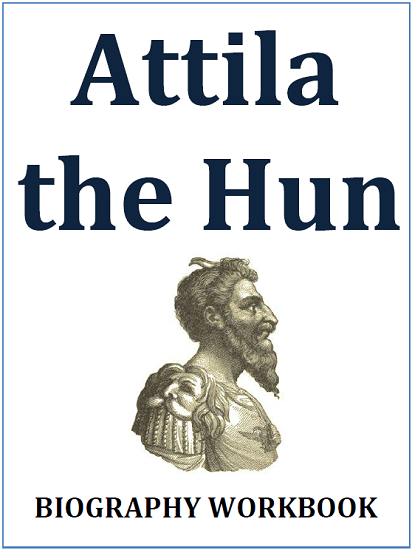
| Attila the Hun Biography Workbook |
|---|
| www.studenthandouts.com ↣ Historical Figures ↣ "A" Names Historical Figures ↣ Attila the Hun Educational Resources |
 |
    |
|
Attila the Hun (circa 406-453 C.E.) - Learn all about this famous and powerful leader of the ancient barbarian Huns, who devastated Europe, only to be stopped short of destroying Rome by the intercession of Pope Leo I.
"Attila the Hun" is eight pages in length and packed with questions and activities alongside its informational text. This item is part of our Biography Workbooks series. Click here to print. The answer key is below. The Goths were considered by the Romans to be "improvable barbarians." But the Huns whom Attila led to ravage the fair peninsula were, to the people of ancient Rome, mere Tartar savages of the lowest stamp. All the other invaders of Italy were of Teutonic (Germanic) origin. But the Huns were Mongols from Asia––of such perfect hideousness to European sensibilities of the time that Jornandes regarded them as the offspring of witches and demons. Attila, son of Mundzuk, "the scourge of God," resembled his soldiers in his flat, tan features, deep-set, fierce, rolling black eyes, and short figure. Historically, Westerners viewed the Huns as uncivilizable savages, who might harry a continent, but neither under Attila, nor Genghis, nor Tamerlane, could ever found a centrally organized kingdom. This terrific and brutal little Kalmuck, with his bead-like eyes, this skin-clad devourer of raw flesh, delighted to lay waste whole empires with fire and sword, and to terrify the world. In 434, Attila became king of the Huns with his brother Bleda. In 445, Bleda died, possibly by murder. In 445, Attila, now sole king of the Huns, invaded the Eastern Roman Empire, and ravaged it even to the gates of Constantinople. He was only bought off from destroying it by an enormous tribute. Answer Key - 1. The Huns were from Asia rather than from Europe; 2. A - Bleda; 3. Aetius; 4. He made it look like he'd killed himself; 5. Answers will vary; 6. Defender of a/the city; 7. Attila was awed by religion in general; 8. Italians from Padua fled there when attacked; 9. He choked to death on his own blood after a night of carousing at his wedding feast; 10. Barbarian groups that had fought alongside the Huns; 11. Answers will vary; 12. D - catastrophe; 13. B - buffooneries; 14. E - countenance; 15. F - demeanor; 16. M - orthodoxy; 17. C - carnage; 18. N - sensibilities; 19. I - inevitable; 20. K - innumerable; 21. O - splendid; 22. H - henceforth; 23. J - infamous; 24. L - irresistible; 25. A - augur; 26. G - harry. |
| www.studenthandouts.com ↣ Historical Figures ↣ "A" Names Historical Figures ↣ Attila the Hun Educational Resources |