

| Punic Wars History Workbook |
|---|
| www.studenthandouts.com ↣ World History ↣ Ancient Rome Educational Resources ↣ Ancient Rome Miscellany |
 |
    |
|
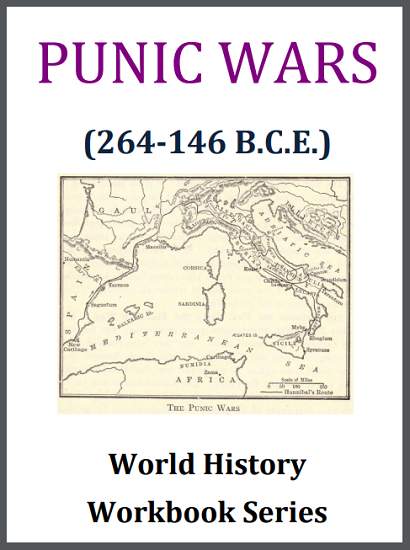
This student-friendly workbook is part of our World History Workbook Series.
"The Punic Wars" focuses on the wars waged between Rome and Carthage (264-146 B.C.E.) that led to Rome's dominance in the Mediterranean region. 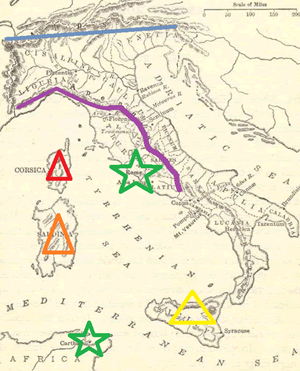 Like all of the workbooks in this series, brief chunks of easy-to-read text are full of fascinating, important information that will intrigue students.
 Interspersed throughout the text are over forty questions and activities, ranging from basic recall, to critical thinking, to map work, to artistic expression, to puzzles. Learning is constantly reinforced throughout the text. Click here to print. This workbook is 15 pages in length. The answer key is below. 7. Using the scale in the top right corner of the map, estimate the distance between Rome and Carthage. circa 370 miles 8. What major city was located in Sicily? Syracuse 9. Ancient Carthage was located on what continent? Africa 10. Ancient Rome was located on what continent? Europe 11. Do you believe that mercenaries make good soldiers? Why or why not? Answers will vary. 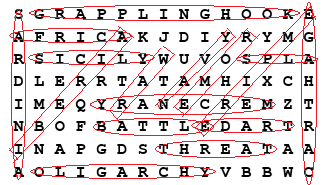 12. Do you think that years of constant warfare increase or decrease people's desire to fight? Explain your answer. Answers will vary.
13. The Romans turned what seemed to be a weakness into a strength through the use of a grappling hook. What might have happened had the Romans given up hope of ever beating the Carthaginians at sea? Answers will vary. Had the Romans surrendered their naval ambitions, Carthage's fleet likely would have dominated Mediterranean supply routes, likely strangling Roman expansion and altering Western history quite decisively. 14. What do you imagine that a typical workday was like for a galley slave? Answers will vary. 15. Warfare in ancient times was, in some ways, more vicious than it is today. It is hard to imagine a modern general tossing a severed head into an enemy camp today. Do you believe that bloody intimidation tactics are useful? Why or why not? Why are they seldom used today? Answers will vary but should include reference to international agreements such as the Geneva Convention. 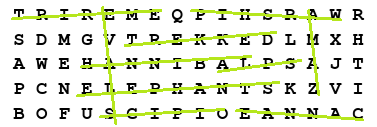 16. Who led the Carthaginian forces during the Second Punic War? Hannibal
17. Who led the Roman forces during the Second Punic War? Scipio 18. Imagine that you are a Carthaginian soldier marching with Hannibal from Iberia to Italy. What might you think about the journey? How might you feel upon finally arriving in Italy? Answers will vary. 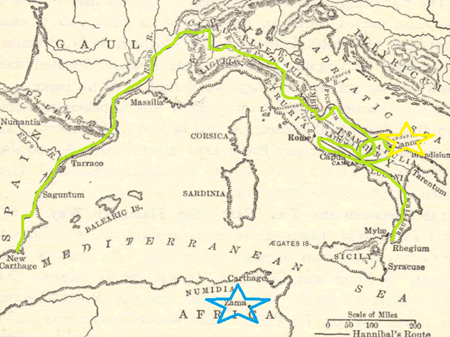 22. What mountain range separates Iberia (Spain) and Gaul (France)? Pyrenees
23. Using the scale at the bottom right corner of the map, estimate the distance between Carthage and Zama. circa 75 miles 24. Using the scale at the bottom right corner of the map, estimate the distance between Cannae and Rome. circa 180 miles 25. Selling conquered people into slavery was a common practice in the ancient world. Do you think that this was fair? What might have happened had conquered peoples been left free to carry on with their lives? Answers will vary. 26. Which of the following modern countries was not under Roman control in ancient times? c. Ireland 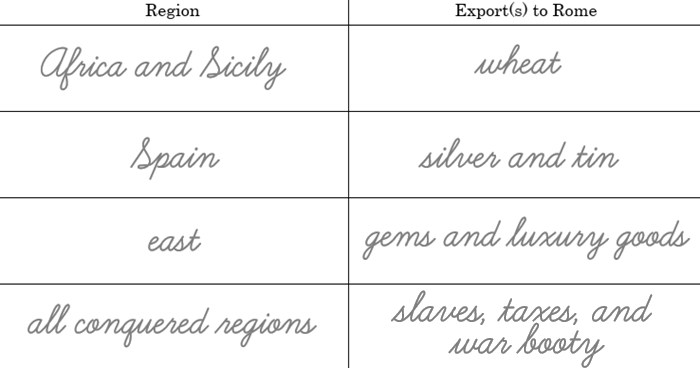
28. Why might a professional (paid) army be less effective than a volunteer army? Answers will vary, but should include reference to the lack of the former volunteer fighting spirit, as well as corruption replacing dedication to public service. 29. Why did the increase in the number of slaves hurt Roman farmers and workers? Slaves gained by conquests displaced free farmers and workers. 30. State, in your own words, how the "Roman mob" was created. Answers will vary. 31. proconsul A proconsul was a Roman magistrate, usually a former consul, granted authority to govern a province and command armies. 32. publican A publican was a private contractor who collected taxes and managed public contracts for the Roman state, often exploiting provinces. 33. latifundia A latifundium was a vast, slave-worked private estate in Roman territory, often displacing small family farms and fueling social unrest. 34. Where was the city of Carthage located? North Africa, in what's now Tunis, Tunisia. 35. What was the basic, underlying cause of all of the Punic wars? The underlying cause was Rome's expansionist drive clashing with Carthage's commercial empire, both vying for dominance over the strategic Mediterranean region. 36. Describe the military actions of Hannibal. Hannibal famously crossed the Alps with elephants, won crushing victories in Italy, but avoided directly besieging Rome itself. 37. Why was it easier for Rome to expand following the defeat of Carthage? With Carthage eliminated, Rome faced no rival navy, enabling unchecked military and economic dominance across the Mediterranean basin. 38. How did Rome grow wealthy as its territory expanded? Rome grew wealthy through war plunder, taxes from provinces, control of trade routes, and massive inflows of enslaved labor. 39. Based on what you have read, what historical figure from the time of the Punic Wars do you find most interesting, and why? Answers will vary. |
| Ancient Rome Books and Films | Ancient Rome Outlines and PowerPoints |
| Ancient Rome Maps and Pictures | Ancient Rome Educational Games |
| Ancient Rome Miscellany | Ancient Rome Worksheets |
| www.studenthandouts.com ↣ World History ↣ Ancient Rome Educational Resources ↣ Ancient Rome Miscellany |