
| Birth of the Hellenistic World History Workbook |
|---|
| www.studenthandouts.com ↣ World History ↣ Ancient Greece Educational Resources ↣ Ancient Greece Miscellany |
 |
    |
|
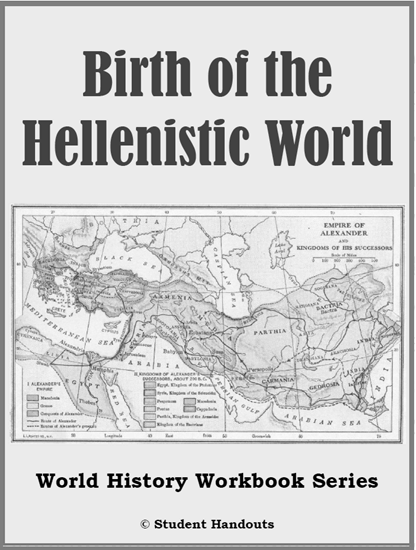
This workbook, eight pages in length, features a readable text interspersed with questions and activities. It is designed for grades seven through twelve. The history of ancient Greece herein described traces the rise of Macedonia, through the conquests of Alexander the Great, through the spread of Hellenistic civilization, which endured until the rise of ancient Rome.
Click here to print. The answer key is below. Excerpt: Alexander's Impact on World History Alexander's most lasting achievement was the spread of Greek culture beyond the Greeks themselves. This spread of Greek culture has been termed "pan-Hellenism."  Alexander married a daughter of Persia's King Darius. He encouraged his soldiers to take Persian wives. Foreign gods and goddesses were worshipped by Alexander and his men, who recognized these deities as foreign incarnations of Greek gods and goddesses.
Trade was encouraged throughout Alexander's empire. To facilitate trade and strengthen his empire, Alexander settled Greeks throughout the lands he conquered. The culture that emerged, mingling Greek traditions with local customs and beliefs, is called "Hellenistic." Answer Key Under what circumstances did Alexander the Great come to the Macedonian throne? Following the unsolved murder of his father. Name at least three modern-day countries which were conquered by Alexander the Great. Egypt, Greece, India, Iran, Iraq, Turkey, et al. Imagine that you are a Babylonian or an Egyptian living during the time of Alexander. How might you view Alexander's conquests? Would you give him the moniker the "Great"? Explain. Answers will vary. What does the term Hellenistic mean? It describes the culture that emerged, mingling Greek traditions with local customs and beliefs, in the areas conquered by Alexander. Describe the work of a Hellenistic scientist or mathematician. Answers will vary. Several are described on pages 4-5: Euclid the father of geometry, Archimedes who had a theory of gravity and designed devices using simple machines, Eratosthenes who measured the diameter of Earth, Aristarchus of Samos who developed the heliocentric model of the universe, and Hipparchus who invented plane and spherical trigonometry. Describe a Hellenistic philosophy. Those described on pages 5-6 are Cynicism, Stoicism, and Epicureanism. Which Hellenistic philosophy do you find most appealing, and why? Answers will vary. This is a perfect opportunity to have a student read and report on The Meditations of Marcus Aurelius. What caused the fall of Hellenistic society? Slave revolts, lack of work for free people because of slavery, and constant warfare which led to conquests, most notably by the Romans. Based on the map, name six major bodies of water that bordered Alexander's empire. Black Sea, Caspian Sea, Mediterranean Sea, Red Sea, Arabian Sea, Persian Gulf. |
| Ancient Greece Books and Films | Ancient Greece Outlines and PowerPoints |
| Ancient Greece Maps and Pictures | Ancient Greece Educational Games |
| Ancient Greece Miscellany | Ancient Greece Worksheets |
| www.studenthandouts.com ↣ World History ↣ Ancient Greece Educational Resources ↣ Ancient Greece Miscellany |