
| Establishment of the Roman Republic History Workbook |
|---|
| www.studenthandouts.com ↣ World History ↣ Ancient Rome Educational Resources ↣ Ancient Rome Miscellany |
 |
    |
|
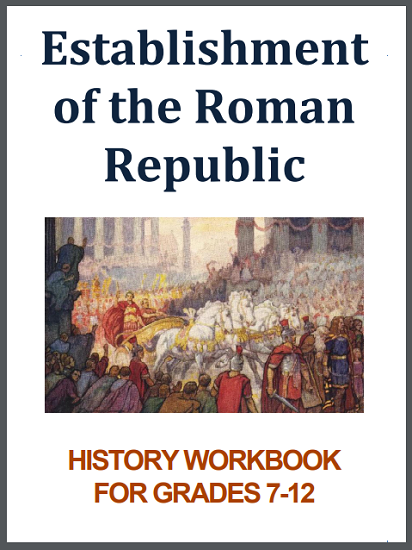
This student-friendly workbook is the first workbook of our four-part World History series on ancient Rome. "The Establishment of the Roman Republic" focuses on the founding of Rome and the establishment of the republic. It covers the political and social structure, Italy's geography and peoples, and so much more. Complex events and concepts are explained in easy-to-understand text without compromising the amount of content. Brief chunks of text are perforated with questions that range from basic recall to critical thinking. There are also illustrations. Our student workbooks facilitate independent learning, working with informational texts, and standardized test preparation skills. Works great as a stand-alone item or as a supplement to a larger unit. This workbook for grades 7-12 is nine pages in length. Click here to print. The answer key is below. ● Why do you think that geographical barriers were necessary for protection in the ancient world? Answers will vary. ● Do geographic barriers provide modern countries with protection? Why or why not? Give at least one example for your argument. Answers will vary. ● Look at the map above. Name at least six regions of ancient Italy. Apulia, Bruttium, Calabria, Campania, Cisalpine Gaul, Corsica (now part of France), Etruria, Latium, Ligurua, Lucania, Picenum, Sabina, Samnium, Sardinia, Sicily, Umbria, Venetia. ● According to this website, who founded Rome? Genetically, Rome was founded by a melting pot of local Italic tribes (like the Latins and Sabines) and neighboring Mediterranean populations, largely descended from Neolithic Anatolian farmers and earlier Bronze Age populations with Steppe ancestry. Here is a more recent article on this genetic history. ● Why do you suppose that we credit the Romans with Etruscan achievements? Consider the phrase: To the victor go the spoils. Answers will vary. ● Accepting these possibilities as facts, why do you suppose that the ancient Romans added the supernatural element of a she-wolf raising two human children? In crafting this element of the legend, what characteristics and traits were the Roman people giving to their culture? Answers will vary. ● Why do you suppose that the study of history is typically divided into different periods? Answers will vary. ● Imagine that you live in ancient Rome. Would you prefer to be a patrician or a plebeian? Why? Answers will vary. ● What group of elected officials eventually took charge of public morality? b. Censors ● How might the modern justice system fail without written laws? Answers will vary, but should include protection from biased judges. ● Why might paying off an attacker not be a good idea? Answers will vary, but should include the simple reality that doing so encourages others to attack you. ● Imagine that you are an ancient Greek, Hebrew, or Sicilian living under Roman control. List two pros and two cons for life under Roman rule. Answers will vary.
|
| Ancient Rome Books and Films | Ancient Rome Outlines and PowerPoints |
| Ancient Rome Maps and Pictures | Ancient Rome Educational Games |
| Ancient Rome Miscellany | Ancient Rome Worksheets |
| www.studenthandouts.com ↣ World History ↣ Ancient Rome Educational Resources ↣ Ancient Rome Miscellany |